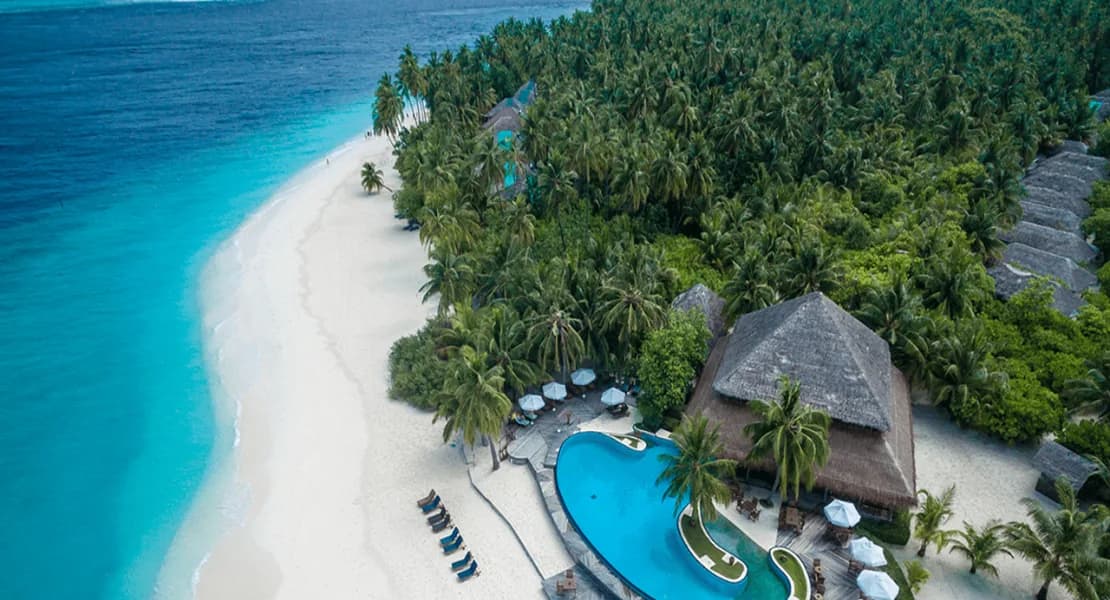
Faafu (Nilandhe North) Atoll, read carefully
One of the country's smaller atolls by resort count, anchored by Filitheyo Island Resort since 2000 and a Werner Lau dive operation that has built the structural reputation. 30 to 40 minutes by seaplane from Velana, strong house-reef quality, and a local-island layer on Magoodhoo and Nilandhoo for divers comfortable with the guesthouse operational model. The atoll's case is best made to dive-primary travellers at the mid-range tier looking for the quieter end of the central-south cluster.
Geography
Faafu (administratively Faafu, geographically Nilandhe Atholhu Uthuruburi or Nilandhe North) sits roughly 120 kilometres south-west of Male along the country's western longitudinal axis. The atoll runs about 25 kilometres long with a roughly oval shape, holding 23 islands of which 2 operate as international resorts and 5 carry local-island settlements. Magoodhoo is the administrative capital and the largest inhabited island; Nilandhoo carries the second guesthouse layer.
The atoll's eastern reef boundary opens onto channels that feed the deep-water side of the central-south Maldivian range. Hard-coral cover recovered after the 2016 bleaching at the country average pace; the channel-side reefs hold slightly stronger condition than the lagoon-interior sites. The atoll-interior shallows are calm and clear, well-suited to surface-interval snorkel programmes between the boat dives.
The Filitheyo anchor
Filitheyo Island Resort opened in 2000 on Filitheyo island at the atoll's south-eastern reef edge. The property carries 125 villas across beach and water configurations at the mid-range tier, with an all-inclusive plan calibrated for divers running two to three tanks daily. The Werner Lau Diving Centre operates the dive programme as an in-house structural amenity rather than an outsourced concierge, with the German-market dive-traveller weighting that defines much of the Faafu booking flow.
The continuity is the property's structural feature. Filitheyo has operated under largely the same German management group since opening, with staff retention that the Italian and German dive-market travellers explicitly cite in the trip-report data. Couples on a return-stay visit recognise the dive guides and the front-of-house team across multi-year gaps, a continuity that the chain-luxury Maldivian average does not match.
The dive case
Faafu's dive identity rests on the house reef plus the eastern channel sites. Filitheyo Reef wraps around roughly two-thirds of the island perimeter and runs strong soft-coral cover with reef-shark presence on the channel-facing side; the structural consequence is that house-reef diving carries a depth comparable to most boat-dive sites at peer atolls. Two Brothers and Filitheyo Kandu on the south-eastern reef edge run the channel-drift programme with grey reef shark and eagle ray sightings on the incoming tide. Ali Thila and Kuda Thila are the named pinnacle sites with strong macro photography and reef-fish density.
The Werner Lau Diving Centre operates as a dive-school plus dive-operator combination, with PADI certification courses, Nitrox specialty programmes, and a regular night-dive schedule. The operation is competent rather than dive-specialist at the marine-biology research tier; readers wanting a research-led programme should compare [Six Senses Laamu's marine-biology programme](/resorts/six-senses-laamu). Visibility tracks data-assets/dive-visibility.json.
The local-island layer
Magoodhoo is the atoll's administrative capital and carries a small guesthouse cluster operating at the budget dive-traveller tier. The local-island model means simpler accommodation (3 to 4 star equivalent), restaurant rather than all-inclusive dining, and a structural cultural-immersion layer that the resort-island monoculture does not deliver. Nilandhoo carries the second guesthouse cluster at smaller scale.
The local-island operational model suits divers prioritising dive-quality and local-culture over resort-island infrastructure. For the structural cultural contrast with the resort-island monoculture, Faafu's local-island layer is a stronger entry than the equivalent layer in the central-atoll cluster, partly because the resort scale is smaller and partly because the atoll's overall booking flow is dive-led rather than honeymoon-led.
Transfer from Malé
Seaplane is the operator default. Trans Maldivian Airways operates the 30 to 40 minute flight from Velana International to the resort seaplane platform, followed by a roughly 10-minute dhoni to the resort jetty. The schedule runs roughly 06:30 to 16:00 local with the standard daylight-only constraint; international arrivals after 14:00 typically overnight at the Velana airport hotel.
The local-island guesthouse model uses public ferry transport from Male, with the crossing taking roughly 4 to 5 hours on the MTCC schedule. For budget dive travellers, the ferry option opens the atoll at materially lower transit cost than the seaplane-only resort routing. The seaplane and domestic-transfer planner models both paths.
Best time to visit
The central-south seasonality applies. November through April is the dry window with the cleanest visibility, calmest channel water, and the strongest dive-programme cadence at Filitheyo. May through October carries the southwest monsoon with reduced visibility on the channel side, calmer lagoon water, and the lower rate window for the all-inclusive plan. The atoll's overall booking pressure runs below the central-atoll cluster, with peak-window availability typically open four to five months ahead rather than the year-ahead booking horizon at the chain-luxury properties.
Comparison with neighbouring atolls
vs Dhaalu: Dhaalu carries the six-resort spread (St. Regis, Niyama, Kandima, Sun Siyam Iru Veli, Angsana Velavaru, Vilu Reef) plus the Kudahuvadhoo domestic airport. Faafu carries the single-anchor Filitheyo model plus the local-island layer. For chain-luxury choice, Dhaalu; for the quieter dive-anchored single-resort stay, Faafu.
vs Meemu: Meemu is the structural twin atoll directly east, with similar low resort density and a comparable dive-anchored identity. Faafu's edge is Filitheyo's longer operating history (2000 vs 2002 Meemu peer openings) and the established Werner Lau dive operation. Both atolls suit divers prioritising the quiet end; the operator continuity is the differentiator.
vs Alif Dhaal (South Ari): South Ari is dive-led with the year-round whale-shark route as the structural identity and a much larger resort cluster. Faafu carries the single-anchor model with the quieter operational cadence. For a dive-primary trip with single-species headline, South Ari; for the quieter dive-anchored stay at the budget-mid-range tier, Faafu.
Resorts in Faafu Atoll
Filitheyo Island Resort (opened 2000, German management group, Werner Lau Diving Centre in-house) anchors the resort tier. A small boutique-and-guesthouse layer on Magoodhoo and Nilandhoo serves the budget dive traveller at the local-island operational model.
Filitheyo Island Resort
Full reviewAitken Spence Hotels Sri Lankan-operator dive-focused premium-all-inclusive on Filitheyo island, Faafu Atoll.
Maldives Idylls editorial. Verified 14 May 2026. Next refresh: 12 August 2026.