Laamu Atoll, read carefully
The country's most secluded luxury atoll. One major operator (Six Senses Laamu) on Olhuveli island, the strongest surf break in the country (Yin Yang) at the doorstep, the country's deepest marine biology programme as on-island infrastructure, and a far-south position that filters out the central-atoll boat traffic entirely. Laamu is not for every trip, but for the trips it fits, it has no peer in the Maldivian map.
Geography
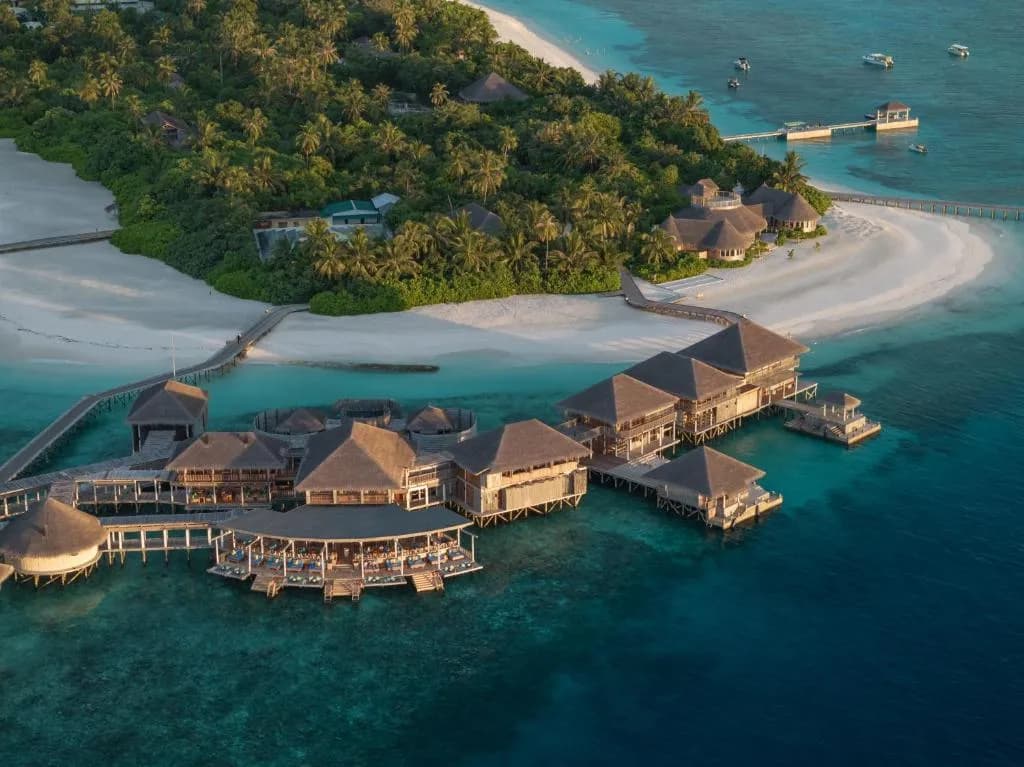
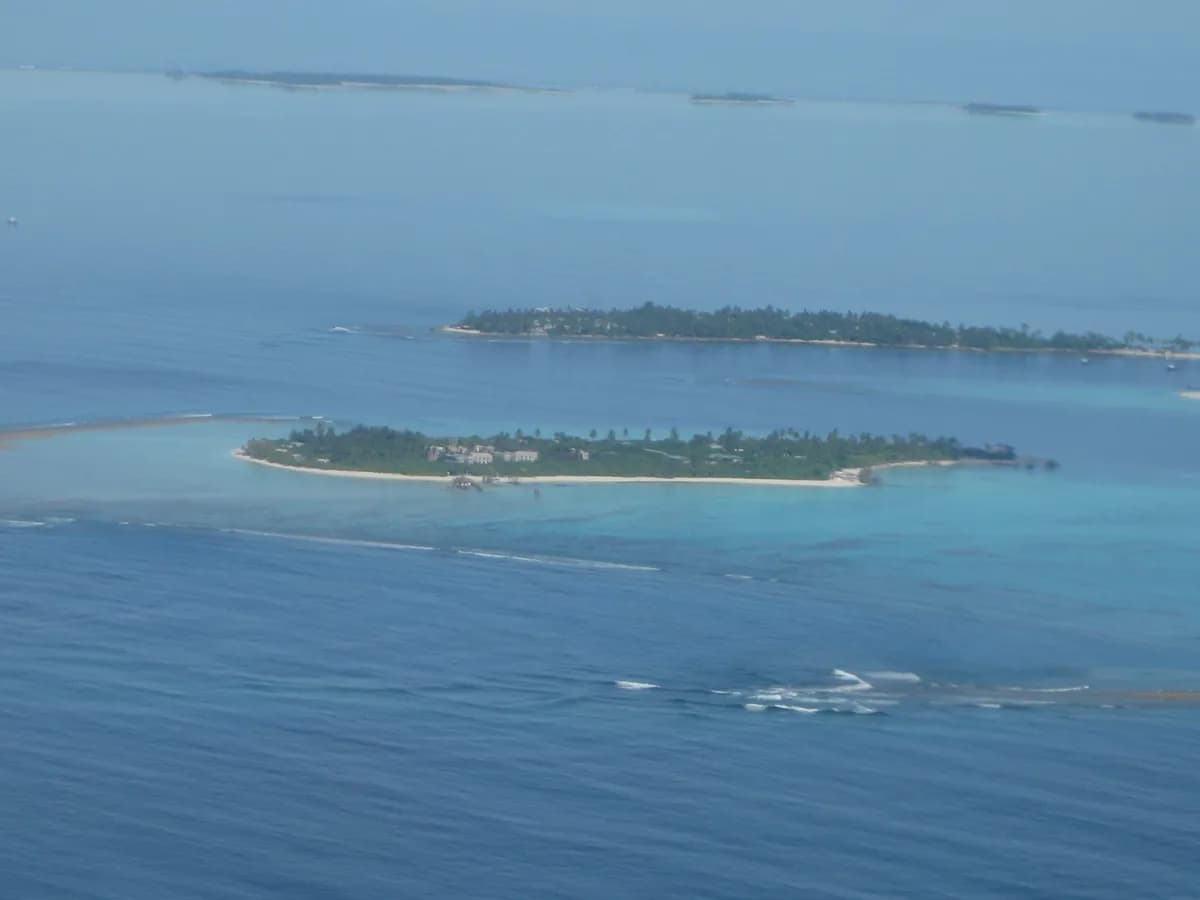
Haddhunmathi Atoll, administered as Laamu, sits about 400 kilometres south of Malé on the southern reaches of the Maldivian archipelago. The atoll runs roughly 65 kilometres north to south and 15 kilometres east to west, with around 12 inhabited islands and a single major resort island (Olhuveli, on the northwestern edge). Kadhdhoo Airport, the regional hub, sits in the centre of the atoll and serves the domestic flight from Malé.
The atoll's shape is unusual: less defined than the central atolls, with a single long ridge of islands rather than the perfect ring structure of Baa or Noonu. The eastern outer reef catches the southwest swell directly, which is what produces the Yin Yang surf break out front of Olhuveli. The western lagoon is calmer and serves the local-island ferry routes.
History
Tourism arrived in Laamu late. Six Senses Laamu opened in 2011 as the atoll's first international resort, and remains the only major operator inside Laamu's administrative footprint. The neighbouring atolls (Thaa to the north, Gaafu Alifu to the south) have similarly thin resort clusters; the southern Maldivian tourism economy has not built out at the scale of the central atolls.
The absence of competing operators is the atoll's structural feature rather than an accident. Maldivian planning has limited resort development in the southern atolls deliberately, partly to protect the reef systems that have recovered better than the central-atoll average, and partly because the transfer infrastructure (a domestic flight rather than a seaplane) does not support the density the central atolls handle.
The single-dominant-resort context
For an atoll visit, this means Six Senses Laamu is effectively the only choice. There are no neighbouring properties to switch to, no boat trips to other luxury islands, and no shared infrastructure with another brand. The atoll is the resort and the resort is the atoll, which is either the brief's perfect match or the trip's wrong design.
Local-island guesthouse tourism exists in Laamu (Hithadhoo and Gan, the two largest local islands, both have small guesthouse clusters), but the operational scale and the cultural register differ from the resort tier in ways that make a mixed Six Senses plus guesthouse stay impractical. Travellers who want Maldivian local-island life should look at South Malé or Maafushi instead.
Surf country
The Yin Yang break runs out front of Six Senses Laamu and is the country's most consistent right-hander. The break works on a southwest swell from late April through October, holds overhead during the peak months of July and August, and runs roughly chest-high through the shoulder season. It is not a beginner break; the bottom is shallow reef, the take-off is fast, and the bail-out is technical.
The resort runs guided surf trips to Yin Yang plus the surrounding atoll breaks (Machine, Isdhoo) for guests who can already paddle out and read a set. The instructor team is genuinely competent rather than chain-template, and the equipment programme covers longboard, shortboard and SUP. Trip-report data consistently ranks the Laamu surf programme in the top three Maldivian options.
Honest caveat: the surf is the atoll's seasonal identity. From November through April the swell is small and the break is mostly flat. A trip planned for the dry-season weather window will miss the surf entirely; a surf-led trip should plan around the May-October window even if the weather is wetter.
Marine biology programme
The Maldives Underwater Initiative (MUI) is the on-island marine biology lab at Six Senses Laamu, and is the country's deepest research-led marine programme. The lab staffs three NGO partnerships from the property: the Olive Ridley Project for sea turtle rehabilitation, the Manta Trust for citizen-science manta logging, and the Blue Marine Foundation for atoll-wide protected-area research.
The published research output includes peer-reviewed papers and policy submissions to the Maldivian Ministry of Environment. Guest engagement with the lab runs from daily snorkel briefings through structured Junior Marine Biologist programmes for children aged six and up; the depth of programming is meaningfully above the country's chain-luxury average.
The Olive Ridley turtle hospital is the country's only resort-based marine turtle rehabilitation centre. Guests can observe rehab in progress and, when releases happen, can be present at the release. The trip-report data flags this as the most memorable single experience for guests who travel with children.
Transfer from Malé
The transfer is a 50-minute domestic flight from Velana International to Kadhdhoo Airport, then a 15-minute speedboat to the resort jetty. The domestic flight operates on Maldivian and Manta Air, with departures roughly from 06:30 to 21:00, which removes the seaplane curfew problem that constrains the central-atoll transfers.
For travellers landing on long-haul flights from Europe and East Asia where arrival times are unpredictable, the schedule resilience is the practical advantage. A 22:00 arrival into Velana connects to a next-morning domestic; a 22:00 arrival into a seaplane atoll loses a full day. The total door-to-door time from international arrivals to resort jetty is around two and a half to three hours including transit.
Best time to visit
Laamu's seasonality runs about a month behind the central-atoll calendar. The dry window holds longer (December through May), and the southwest swell from May through October delivers the surf season and the strongest sea-life sightings on the outer reefs.
For a non-surf trip, late February through April is the strongest combination of weather and value. For a surf-led trip, July and August are the peak swell months, with the trade-off of more frequent rain. The wellness arc and the marine biology programme run year-round; the seasonal differentiator is the surf and the dive site rotation.
Comparison with neighbouring atolls
vs Addu Atoll (Seenu): Addu is the southernmost atoll, two flight legs from Malé, with a different ecosystem (post-2004-tsunami coral recovery profile, equatorial reef life that the rest of the Maldives does not see). Addu has multiple operators and a road network; Laamu has one operator and isolation. The choice is between Addu's breadth and Laamu's depth.
vs Gaafu Alifu: Gaafu Alifu is the atoll between Laamu and Addu, with a smaller resort cluster and the country's deepest dive sites at Wattaru Kandu. Gaafu has Park Hyatt Hadahaa and Ayada as the two major operators; the dive intensity is higher than Laamu, the marine biology programme is thinner.
vs Thaa Atoll: Thaa sits directly north of Laamu with a single major operator (COMO Maalifushi). The two atolls share the southern-Maldives identity, but Thaa is more dive-focused and lacks Laamu's surf break. For a divers-primary trip with no surf interest, Thaa is the quieter alternative.
Resorts in Laamu Atoll
Single-operator atoll. Six Senses Laamu carries the international resort traffic; the rest of the atoll runs as local-island life.
Six Senses Laamu
Full reviewThe only resort in Laamu, with the most editorially engaged marine biology programme in the country and surf…
Maldives Idylls editorial. Verified 13 May 2026. Next refresh: 13 May 2027.