Six Senses Laamu
The only luxury resort in the southern atoll, paced for divers and surfers who also read, with the most editorially engaged marine biology programme in the country.
Six Senses Laamu sits alone on Olhuveli island in the southern atoll of Haddhunmathi (Laamu), four hundred kilometres south of Velana and a domestic flight plus speedboat away from the central-atoll cluster. It is the only resort operator in the atoll, and the social design of the place inherits that fact: no neighbouring properties, no day-trip overlap with another brand, the dive boats are not sharing a channel with anyone else. The Six Senses chain's wellness DNA holds at Laamu, but the property is more interesting for what it adds to the chain script, a marine biology programme that publishes research with the Maldives Resilient Reefs initiative, a surf programme built around the Yin Yang break out front, and the country's strongest Olive Ridley turtle rehabilitation partnership. Whether the long transfer is worth it is the page's main question.
Setting
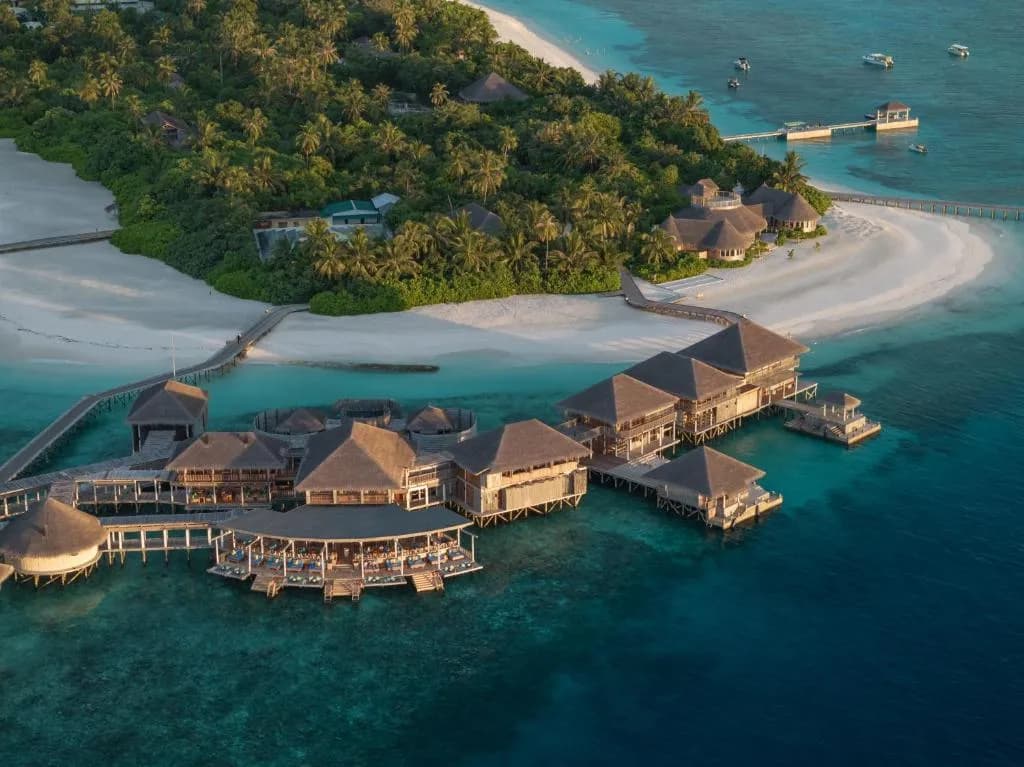
The resort occupies the entire island of Olhuveli, which sits at the northwestern edge of Laamu Atoll. The island is small, roughly nine hundred metres long, and most of the resort's footprint is over-water: the boardwalk arrangement extends from the central jetty along three directions, with beach villas tucked into the limited land mass and water villas strung along the boardwalks.
The atoll itself is one of the country's southernmost, sitting around 200 km north of the equator. The wet-and-dry seasonality is shifted relative to the central atolls: the dry window holds slightly longer (December through May), the southwest monsoon's heaviest rain falls earlier (June into July), and the surf swell from May through October is the strongest in the country.
Critique: the over-water-heavy footprint means the beach is short by Maldivian standards. A guest who wants a long sandy walk after dinner will find the loop is twenty minutes around. This is not the resort for guests whose mental image is a wide beach for sunrise jogs; it is the resort for guests whose mental image is the lagoon under the deck.
Who it's for
- Couples who dive together. The house reef, the channel currents, and the wider Laamu Atoll dive sites are some of the strongest in the country, and the resort dive operation runs at a pace closer to a dedicated dive resort than a luxury chain.
- Surfers, especially those who can hold a longboard line on a fast right. The Yin Yang break sits about a five-minute boat from the resort jetty, in season from late April through October.
- Travellers who care about marine biology as content, not theatre. The on-island lab and the resident biologists run a daily programme that goes beyond the snorkel-with-the-fish format, with citizen-science manta logging and an Olive Ridley turtle hospital partnership.
- Families with children old enough to engage the Junior Marine Biologist programme. The kids' club has substance, and the structured day at Laamu reads better for an eight-year-old than the open-pacing at Soneva would.
Who it isn't for
- Travellers who want a short transfer. The domestic flight to Kadhdhoo plus a speedboat to Olhuveli takes the better part of a day; if your inbound from Europe lands in the afternoon, you overnight at the airport hotel.
- Couples who want a busy resort scene with neighbouring properties to walk to or boat to. The atoll has no other luxury operator. The isolation is the design, but it is the wrong design for guests who get restless on day three.
- First-time visitors looking for a postcard over-water-bar with a DJ. The bar scene at Laamu is the Chill Bar at sunset, not a club. The vibe is observatory, not nightclub.
- Travellers who prioritise polish over substance. Six Senses operations are good rather than perfect; a guest who notices the seam on a napkin will find Laamu less consistently buttoned-up than Cheval Blanc or Four Seasons.
The villas
Laamu's villa stock divides between beach-side and over-water, with the family inventory tilted toward beach residences and the romantic inventory tilted toward water villas. The table below covers the four categories that drive most bookings; specialised retreats sit beyond and are offered on enquiry.
| Villa | Size | Sleeps | Pool |
|---|---|---|---|
| Ocean Beach Villa with Pool | 196 m² | 2 | Yes |
| Family Beach Villa with Pool | 220 m² | 4 | Yes |
| Laamu Water Villa with Pool | 175 m² | 2 | Yes |
| Two Bedroom Ocean Beach Villa | 470 m² | 4 | Yes |
| Sunset Beach Villa with Pool | 200 m² | 2 | Yes |
Food & drink
Six on-island venues, each carrying a specific role. Leaf is the all-day pavilion built on stilts over the resort's organic garden; lunch here is the calmest meal of the day and the strongest argument for staying on the property rather than dispatching to a dive boat at midday. The garden supplies the kitchen directly, the leaf-to-plate routing is real, and the menu rotates with what the gardens are yielding that fortnight. Chef Raphi has built a Maldivian Blue Zone tasting menu out of the same garden, drawing on the longevity-research vocabulary; the menu reads honest rather than themed, and it works for guests who want plant-led food across a multi-night arc rather than a single dinner.
Zen is the Japanese counter for dinner, with sashimi from local fishermen and a small but capable wine list. Longitude is the breakfast room with the broadest spread and the standard all-day Western menu the rest of the time. Sip Sip is the laid-back bar venue over the lagoon; Chill Bar carries the sunset programme with the better cocktail menu and the slightly louder atmosphere.
The destination dining programme is the one that earns its place. Sandbank dinner, served on a private sandbar at sunset with a personal chef and waiter, is the experience that the trip-report data ranks highest across the last three seasons. Book it once. Then book in-villa dinner on a different night and skip the sandbank repeat; the operational team will press for the second sandbank, but the in-villa shape changes the rhythm of the week.
Diving and the house reef
The Laamu Atoll dive operation is one of the most ambitious in the country, and the strongest argument for the long transfer. The house reef on the western side of Olhuveli has been monitored continuously since the resort opened in 2011; coral cover is documented to recover faster here than at most central-atoll house reefs because Laamu sits outside the warm-water bleaching corridor that hit the central atolls hardest in 2016. The Marine Biology team logs every dive in a public-facing database, and the data is the source for the Maldives Resilient Reefs research collaboration.
Outer-reef dive sites at Laamu Atoll include Hithadhoo Corner, Mundoo Corner, and Munyafushi Kandu. Currents at the channel sites run fast enough that drift dives are the standard format; the dive guides are good at reading the tide tables and the briefings are direct about what to expect. Hammerheads and grey reef sharks are common; manta sightings increase from June through October.
Critique: the dive boat fleet is smaller than the operation deserves. On peak weeks a popular site sees two of the resort's boats stacked on the same brief, which the guides handle gracefully but which slightly dilutes the experience. If diving is the entire purpose of the trip and the budget allows, a Laamu liveaboard for a week and a Six Senses stay for a week is the better split than two weeks at the resort.
Spa and wellness
The Six Senses spa at Laamu carries the chain's signature wellness programming. The footprint is meaningful (six treatment rooms, a yoga pavilion, a sleep-tracking sleep doctor consultation room), and the practitioner roster has held steady longer than most Maldivian resort spas. The arrival ritual runs through a wellness consultation that genuinely shapes the treatment selection rather than serving as a sales gate.
The standout offering is the integrated wellness arc: a five-day or ten-day programme that combines body work with the sleep doctor, the in-house biohacker, and the nutritionist. The trip-report data ranks the Laamu wellness arc above the equivalent Soneva offering on substance, slightly below on pacing. Couples who arrive specifically for the spa should request the arc rather than treating the spa as an a-la-carte add-on.
Honest caveat: the spa is small enough that peak-season booking pressure can frustrate walk-ins. If a wellness arc is part of the trip, lock the slots at the time of confirming the reservation.
Activities and the on-island programme
The Marine Biology Junior programme is the activity that earns the resort its space in this guide. Children aged six and up enter a structured pathway that begins with reef-fish ID and progresses through citizen-science survey methods. The programme runs daily and is supervised by working biologists, not entertainment staff. Trip reports across the last three seasons consistently rank this offering as the differentiator that pulls families with school-age children south to Laamu rather than to a more central-atoll family resort.
The surf programme is the second pillar. The Yin Yang break out front is a fast right-hander that runs from late April through October, holding consistent overhead surf on a southwest swell. Laamu also runs guided trips to Machine and Isdhoo breaks within the atoll. The programme runs under the Tropicsurf partnership; the instructors are working surfers and the equipment fleet covers longboard, shortboard, and SUP. Beginners are matched to the smaller breaks; the Yin Yang is for guests who can already paddle out and read a set.
The smaller-scale offerings: the destination dinner setups (sandbank, in-villa, over-water-deck), the dolphin cruise that runs roughly four out of five evenings in season, the kite-surfing programme during cross-shore wind windows, and the private-island day trip to an uninhabited sand cay. The bicycle and golf-cart transport on Olhuveli works but the island is small enough to walk; the speedboat fleet is the more relevant transport for guests venturing out.
Getting there
The transfer is a domestic flight from Velana International to Kadhdhoo Airport (around 50 minutes on Maldivian or FlyMe), followed by a 15-minute speedboat from Kadhdhoo to the resort jetty. The total door-to-door from the international arrivals hall is around two and a half hours including waits; the domestic departures area at Velana is on the far side of the airport and the resort's ground staff meet inbound guests at the international door.
The domestic flight schedule is more forgiving than the seaplane window. Departures run roughly from 06:30 to 21:00, which removes the seaplane curfew problem entirely; a guest landing at Velana at 22:00 catches the next morning flight without an airport-hotel overnight. For travellers on long-haul flights from Europe and East Asia where landing time is unpredictable, this is the strongest argument for a southern-atoll resort over a central-atoll one.
Visa: most nationalities receive a free 30-day visa on arrival. Passport must be valid six months past entry. Departure tax is included in the airline ticket since 2016 and does not need to be paid separately at the airport.
Best time to visit
Laamu's seasonality runs about a month behind the central-atoll calendar. The dry window of December through May holds slightly longer than at Baa or Noonu, and February through April is the peak combination of calm sea, low rain probability, and post-Christmas rate adjustment.
The May-through-October window is the second window worth planning around. Rates drop, the southwest swell delivers consistent surf at Yin Yang, and manta sightings on the outer reefs increase markedly. The trade-off is that the same window carries the heaviest rainfall of the year, and full overcast days are more common than at the central atolls.
Worst window: June, when the southwest monsoon is fully established and European school holidays push rates back up despite the weather. Late November is the contrarian's pick, after the surf season has wound down and before the December rate spike arrives, with the best chance of empty sites.
Sustainability, the numbers
Six Senses Laamu publishes a monthly sustainability transparency report on the property's microsite. The reporting cadence is unusually frequent for the industry; most peer properties publish annually, and most luxury chains publish nothing property-specific. The data covers energy intensity, water bottling counts, food waste, plastic offset, and the community grant outflow to the surrounding atoll.
The on-island water bottling operation produces glass-bottled still and sparkling water at scale; the single-use plastic count has been zero since 2017 according to the published reports. The Earth Lab recycling shed handles on-island waste sorting; the resort claims a 70%+ diversion-from-landfill rate for non-organic waste and 100% for organics through the compost programme.
The community side is the more interesting half. The Maldives Underwater Initiative (MUI) staffed at Laamu runs three NGO partnerships from the property: the Olive Ridley Project for sea turtle rehabilitation, Blue Marine Foundation for Hanifaru-style marine protected area research, and Manta Trust for citizen-science manta logging. None of these are theatre; the published outputs include peer-reviewed papers and atoll-wide protected-area policy submissions.
Six Senses Laamu is the right answer for a specific kind of traveller, the one who values the marine programme, the surf, and the solitude of the southern atoll over the polish of a more central-atoll resort. The transfer length is real, the social isolation is real, and the operational consistency runs slightly below the country's top tier. None of that disqualifies the resort; it just means the choice is not for everyone. For couples who dive, families with marine-curious children, and surfers who can hold a longboard line, this is the strongest single-resort option in the country. For the broader divers-and-marine-research frame, the Lhaviyani Atoll dive site and 5.8 m setting covers the country's peer dive atoll, the Anantara Kihavah reef setting and food programme covers the chain-luxury marine alternative, and the Baa Atoll manta season concentration and the Laamu Atoll geographic and surf context cover the structural marine-event versus marine-research split.
Gallery
Photographs come from each resort's own communications and operator-supplied media kits. Operators retain ownership; takedown requests are honoured on email. Click any tile to view it full size.
Alternatives we would also recommend
Soneva Fushi
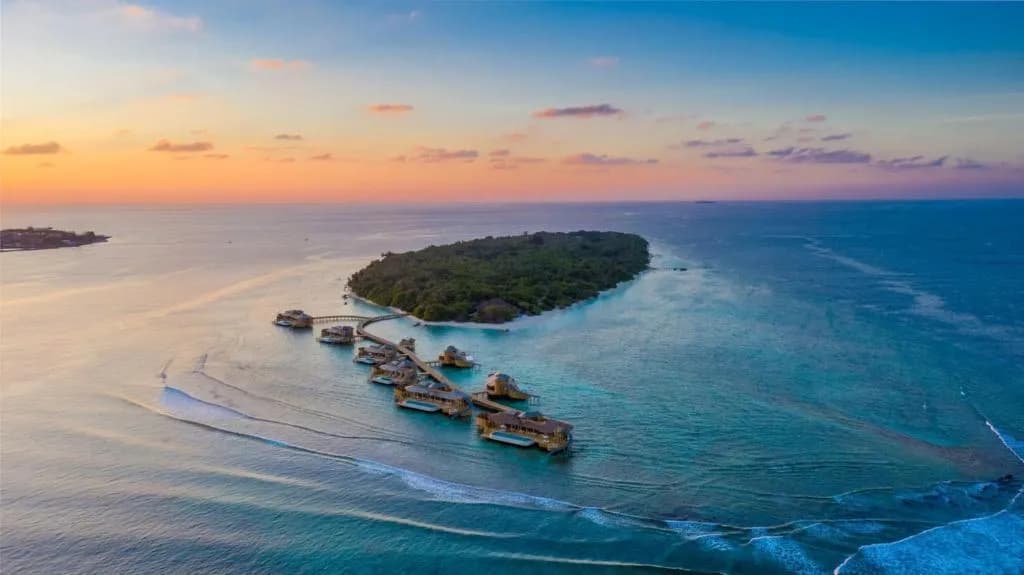
The eco-luxury reference of the country, in the central atolls with manta access in season. Different DNA, similar editorial seriousness.
Check rates on Expedia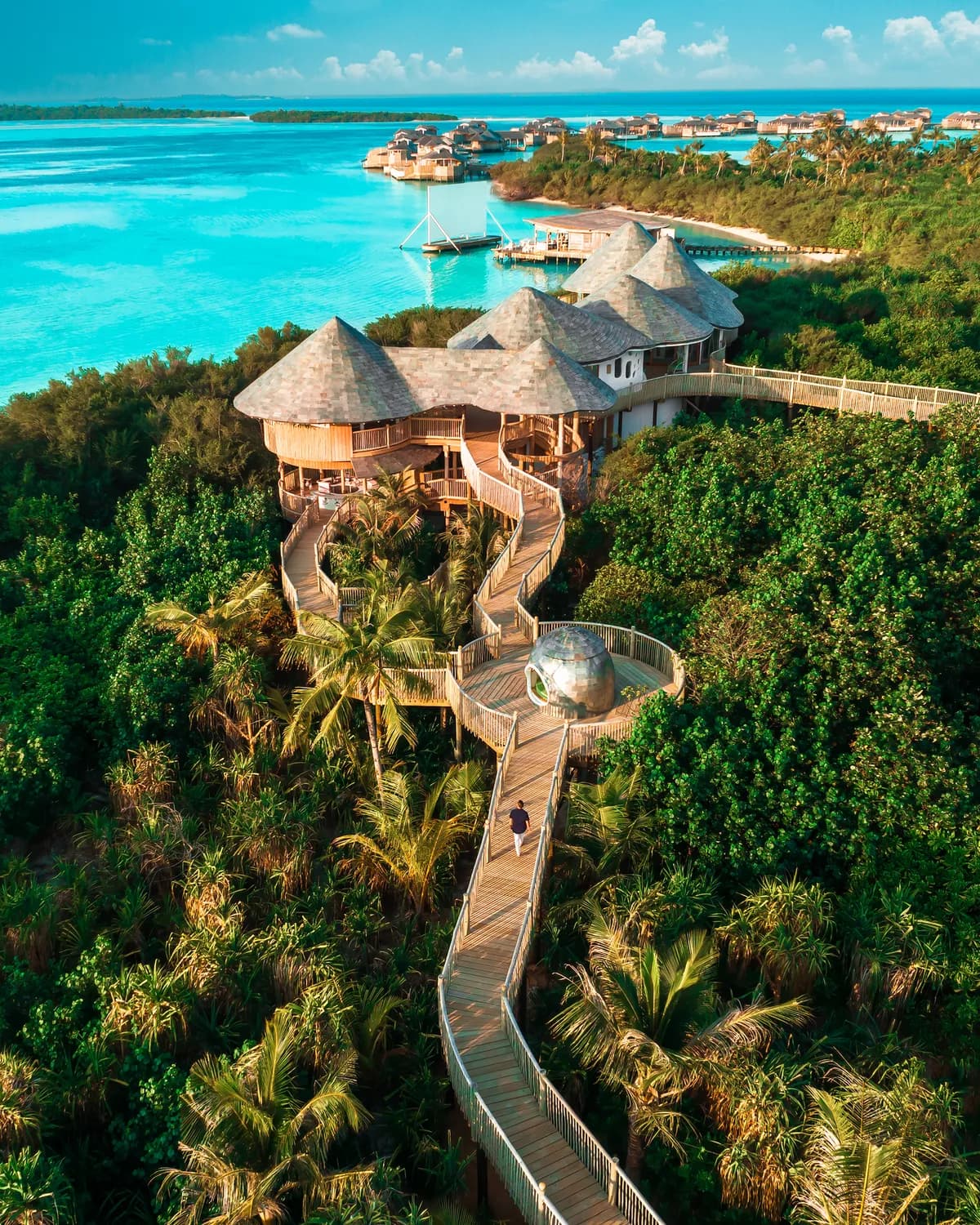
Soneva Jani
Over-water-led Soneva sister property in the central north. Same philosophy, water-villa shape.
Check rates on Expedia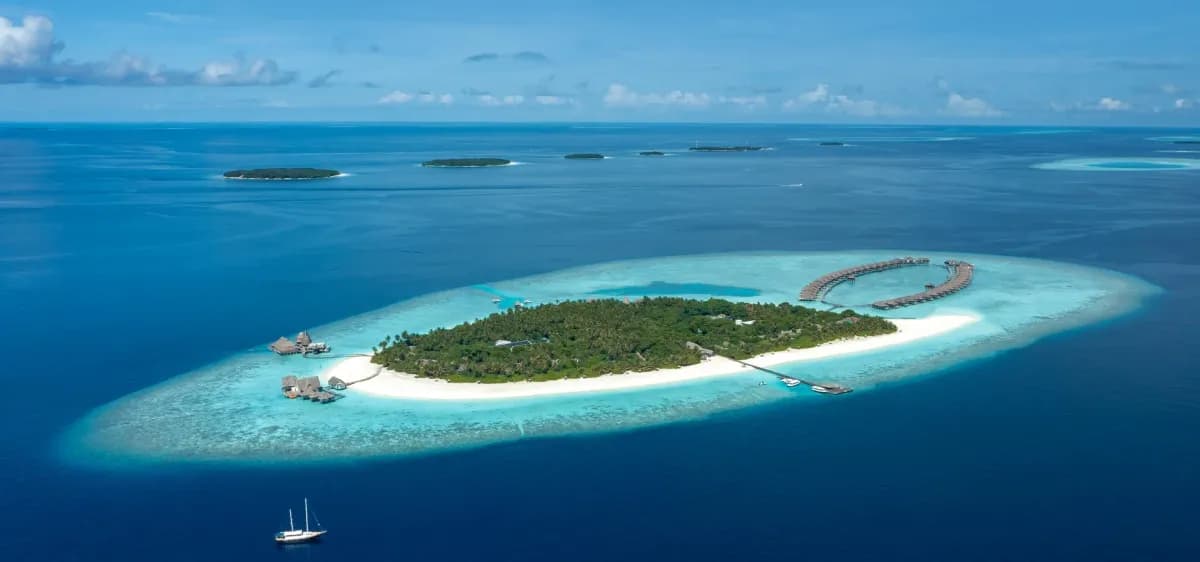
Anantara Kihavah
Underwater restaurant, observatory, manta-window access in Baa. More polished, less editorial.
Check rates on ExpediaHead-to-head comparisons
Frequently asked
- How does the Laamu transfer compare to a seaplane to a central atoll?
- A central-atoll seaplane is roughly 40 minutes and operates only in daylight (06:30 to 16:00). A Laamu domestic flight is around 50 minutes plus a 15-minute speedboat, but the domestic schedule runs from 06:30 to 21:00, so late-arriving international flights connect the same day. The total door-to-door is similar; the schedule resilience is much better at Laamu.
- Is the marine biology programme worth choosing the resort for?
- Yes for a specific traveller: the one who wants research-grade depth rather than entertainment. The on-island biologists run daily structured programming with the Olive Ridley Project, Manta Trust, and Blue Marine Foundation. Trip-report data confirms this is the resort's strongest differentiator. For a guest who reads the marine pages on this site, the Laamu programme will reshape the stay.
- How is the surf actually?
- Yin Yang is the headline right-hander; it runs roughly chest-high to overhead from late April through October, holding consistent on a southwest swell. The resort runs guided trips to Machine and Isdhoo as well. Beginners are matched to smaller breaks; Yin Yang is for guests who can already paddle out and read a set.
- What's the kids' programme really like?
- The Den (ages 4-11) and Junior Marine Biologist (ages 6-12) programmes run daily with substance. The Junior Marine Biologist programme in particular is supervised by working biologists and produces real reef-fish ID skills. Families with school-age children consistently rank this above the equivalent offerings at central-atoll resorts.
- Is the spa worth booking the wellness arc?
- Yes if the trip has at least a week available. The integrated wellness arc with the sleep doctor and the nutritionist requires seven days minimum and reads better in trip reports than the equivalent Soneva or Anantara offering on substance.
- How does the operational polish compare to Soneva or Cheval Blanc?
- Honestly, slightly below. Service consistency is good rather than perfect; the napkin-seam guest will notice. The trade-off is that the substance (marine programme, surf, sustainability transparency) sits above what the polished competitors deliver. Choose Laamu for substance; choose Cheval Blanc for polish.
Last verified 2026-05-27. Next refresh 2026-08-27. Edited by Linus Halberg.