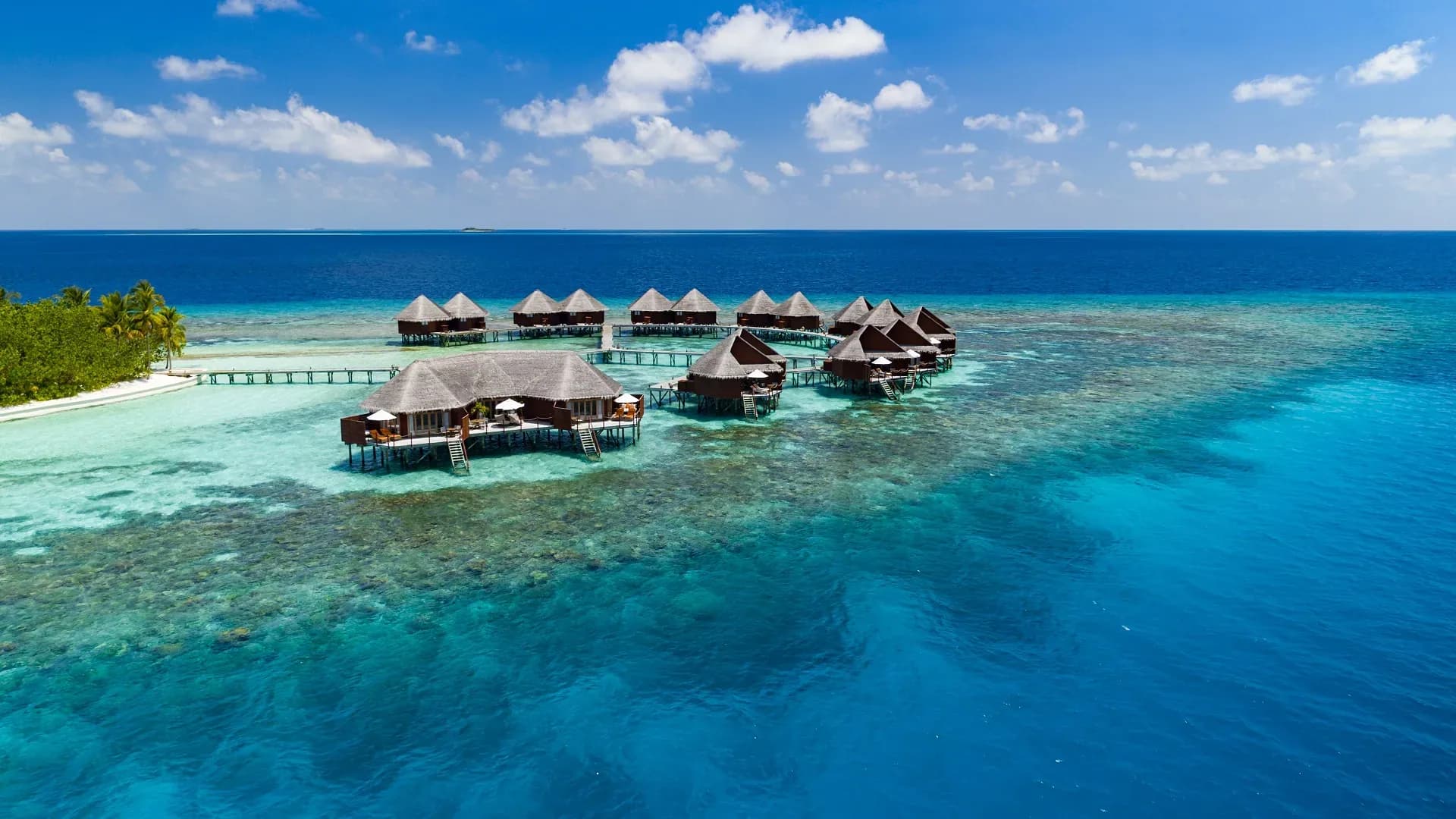
Mirihi Island Resort
Independently operated boutique-luxury on Mirihi island, northern Alif Dhaal (South Ari) Atoll. 36 villas across one of the smallest naturally-vegetated single-resort islands in the country, deliberately un-marketed adults-friendly tone (no kids' club, no over-water bar, the menu cards rotate fortnightly), the house reef consistently rated among the country's strongest three for shore-snorkel and shore-dive access, the answer when the trip identity wants quietness as the product.
Mirihi Island Resort sits on Mirihi island in northern Alif Dhaal Atoll (South Ari), operated independently rather than under a chain-luxury portfolio framework. The structural identity is the operational-quietness compound. Where peer Maldivian luxury properties scale up to 100-plus villas with overlapping kids' programmes, overwater bars, and the standard marquee-restaurant-rotation calendar, Mirihi runs 36 villas across a small naturally-vegetated island of approximately 350 by 50 metres without a kids' club, without an over-water bar, and with a deliberately small dining cluster (the principal Dhonveli all-day pavilion plus the over-water Muraka speciality venue). The brand has never run a marketing-led repositioning cycle; the property's reputation moves through repeat-guest trip-report flow rather than aggregator-driven recognition. Trip-report flow consistently notes two things: the house reef ranks with Soneva Fushi's, Vakkaru's, and the strongest North Ari properties for shore-snorkel and shore-dive density (the reef edge sits 5 to 15 metres from the beach across the entire perimeter), and the operational-warmth runs at the named-staff-recognition pattern that the chain-luxury Maldivian alternatives at multiples of the price cannot match for the multi-year return-visit profile. The 20-minute Trans Maldivian seaplane direct from Velana places Mirihi at one of the shorter Alif Dhaal transfer windows. Across the South Ari cluster, Mirihi occupies the under-marketed boutique-luxury house-reef-anchor positioning that the design-led and chain-luxury alternatives do not occupy; the DRIFT Thelu Veliga sand-spit-island boutique alternative is the structurally-adjacent boutique competitor at a different scale anchor (sand-spit geometry rather than house reef), the LUX South Ari Atoll Mauritian-DNA design-led longer-axis-island alternative is the design-led tier at materially larger scale, and the Soneva Fushi framework-anchored sustainability anchor in Baa is the cross-cohort house-reef peer at radically different commercial polish. Pending operational transition: MGallery Collection (Accor) signed the property to its global portfolio in late 2025; following an extensive renovation and expansion, the site is scheduled to reopen as V Villas Maldives at Mirihi - MGallery Collection in 2026 under VIE Group ownership with a 42-villa Studio Gronda design. This page describes the current independent-operated Mirihi Island Resort configuration; a refreshed page for the V Villas configuration will follow once the reopening operational data lands.
Setting
Mirihi is a small naturally-vegetated island in northern Alif Dhaal Atoll (South Ari), approximately 350 metres along the longer axis and 50 metres across at the narrower section. The 36-villa stock distributes across the perimeter: the beach villas line the eastern and western edges with the dual sun-orientation choice, and the two over-water villa clusters extend from short jetty configurations at the southern end. The principal dining and operational infrastructure sits at the central section.
The small naturally-vegetated geometry is the property's distinctive geographic feature. The native palm canopy and the deliberately-undeveloped beach-back vegetation preserve the small-island feel that aggressive resort-construction across the broader Maldivian luxury cluster has progressively eroded. For travellers prioritising the small naturally-vegetated trip identity rather than the manicured-luxury-island template, the configuration is increasingly rare among Maldivian peers.
Critique: the small scale means the operational infrastructure runs at compact density; the wedding-and-celebration coordination, the watersports programme, and the spa configuration all run at small-island scale rather than the broader-footprint alternatives. The reef-edge proximity to the villa decks also means the beach-and-lagoon photography sits at the close-range scale rather than the wide-vista alternative footprints.
Who it's for
- Couples wanting deliberate operational quietness with no marketing-led brand surface. The 36-villa scale, the absence of the kids' club and the over-water bar, and the deliberately small dining cluster produce a daily rhythm at the operational-quietness depth. For travellers whose previous Maldivian stays produced sensory fatigue from the chain-luxury programming density, Mirihi's restraint is the structural answer.
- Snorkellers and divers anchoring the trip on house-reef quality. The Mirihi reef sits 5 to 15 metres from the beach across the entire perimeter; the density of fish, the variety of coral structures, and the ease of access place the reef in the country's strongest three for the shore-from-the-villa pattern. For travellers building the trip around the daily snorkel rather than the destination-restaurant rotation, the configuration is country-distinctive.
- Repeat-guest profile travellers wanting the named-staff-recognition pattern across multi-year visits. The small-scale operational continuity produces a daily-cadence and named-recognition rhythm that the chain-luxury Maldivian properties at multiples of the price cannot match. Trip-report flow consistently notes the operational warmth across return visits as the property's defining feature beyond the reef.
- Adults-leaning travellers wanting the inclusion of children without the explicit adults-only restriction. Mirihi does not operate an age-restriction policy, but the absence of the kids' club and the deliberately quiet operational tone means the property attracts adults-leaning bookings; families with very young children typically self-select elsewhere. For travellers wanting the operational quietness without the formal age-restriction headline, the configuration sits at the structural sweet spot.
Who it isn't for
- Travellers wanting LVMH-Maison polish at the absolute top tier. Mirihi operates at the deliberately-restrained boutique-luxury depth; for the Maison cadence brief, [Cheval Blanc Randheli in Noonu](/resorts/cheval-blanc-randheli) sits at a clearly higher polish tier with a different commercial model entirely.
- Families with structured-programming requirements. The absence of the kids' club and the deliberately quiet operational tone mean the family-programming surface is minimal; for Alif Dhaal family-strength alternatives, [Lily Beach Platinum Plus inclusion + Turtles Kids' Club](/resorts/lily-beach-resort) and [Centara Grand Island Thai-portfolio family-and-couples](/resorts/centara-grand-island) sit ahead at the same atoll cluster.
- Travellers wanting the marquee single-restaurant or destination-bar experience. The two-venue dining cluster (Dhonveli all-day plus Muraka over-water speciality) means the daily rotation runs at small-venue density. For destination-dining trips, the country's stronger food properties sit elsewhere.
- Travellers wanting Soneva-tier audited sustainability reporting. Mirihi runs operational sustainability discipline without the framework-anchored published-impact-report cadence at the [Soneva framework depth](/resorts/soneva-fushi). The certification surface remains thin against the country's higher tier.
The villas
The 36 villas distribute across Beach Villa and Water Villa configurations along the small Mirihi island. The deliberately restrained inventory (no over-water suites, no presidential category, no separate adults-only cluster) supports the operational-quietness identity. The villa architecture follows the small-island scale: thatched-roof natural-material vocabulary rather than concrete-and-glass design language. Specific square-metre figures vary by sub-category and should be confirmed at booking.
| Villa | Size | Sleeps | Pool |
|---|---|---|---|
| Beach Villa | 75 m² | 2 | No |
| Deluxe Beach Villa | 95 m² | 2 | No |
| Water Villa | 90 m² | 2 | No |
| Deluxe Water Villa | 110 m² | 2 | No |
Food & drink
The dining cluster runs at two venues. The principal Dhonveli all-day pavilion serves breakfast, lunch, and dinner on the rotating-buffet plus à-la-carte template; the menu rotates fortnightly across an international scope with the strong Maldivian and Asian integration. The Muraka over-water speciality venue runs dinner-only with the smaller fine-dining menu; the configuration sits over the lagoon at the southern jetty edge.
The kitchen lineage carries the long-tenure operational continuity that the small-scale boutique model supports; the head-chef changeover cadence runs slower than the chain-luxury Maldivian template, which produces the consistent menu-and-execution standard across the multi-year return-visit pattern. The wine programme runs at the boutique-luxury depth with the European cellar selection emphasised for the German and Scandinavian repeat-guest profile.
Honest read on the food: the two-venue cluster means the daily rotation runs at restricted breadth. For food-led travellers wanting the marquee single-restaurant chef positioning or the broader-rotation breadth, the country's stronger food properties sit elsewhere. Mirihi's food strength is the consistent execution depth and the boutique-scale dining warmth rather than venue count or named-chef positioning.
Diving and the house reef
The Mirihi house reef is the property's structural marine anchor. The reef edge sits 5 to 15 metres from the beach across the entire perimeter; the density of reef fish, the variety of coral structures (the reef survived the 1998 and 2016 bleaching events with stronger recovery than peer South Ari properties), and the ease of access from the villa decks place the reef in the country's strongest three for shore-snorkel and shore-dive density. For shore-diving and shore-snorkel as the trip's daily centre, the configuration is country-distinctive.
Outer-reef dive sites within tender range include the Alif Dhaal channel cluster (Kuda Rah Thila, Maaya Thila pinnacle dives, Madivaru manta-cleaning station seasonal rotation), and the year-round whale-shark corridor along the southern reef edge of Alif Dhaal within day-trip routing. The on-property Ocean-Pro dive school operates at the boutique-luxury cadence with the small-group dive-boat configuration; the dive-school instructor continuity matches the wider property's small-scale operational warmth.
Honest caveat on the dive operation: for dive-specialist depth at the chain-luxury polish, Six Senses Laamu delivers more programme depth and the dedicated marine biology team. Mirihi's strength is the house-reef arithmetic and the small-group dive-boat configuration rather than the certification-course portfolio depth.
Spa and wellness
The Duniye Spa operates at the central section of the island with the treatment-pavilion cluster covering single and couples' configurations, the steam and sauna circuit, and the yoga programme. The spa runs at the boutique-luxury wellness depth supporting the post-flight recovery and the multi-treatment holiday-week cadence; the small-scale wellness operation matches the wider property's deliberately restrained programming tone.
Treatment menu covers the standard massage, facial, body-and-scrub strands plus the Asian wellness modalities consistent with the broader Maldivian boutique-luxury standard. The spa runs as the standard upgrade path through the trip; the small-scale therapist roster supports the named-recognition pattern that the wider operational warmth carries.
Honest caveat on the spa: for wellness-immersion as the trip's centre, JOALI BEING in Raa Atoll at the adults-only wellness-island configuration sits a clear tier above with the built-in wellness-infrastructure programme. Mirihi's spa delivers the supporting wellness layer alongside the house-reef-centred trip rather than the wellness-as-product centre.
Activities and the on-island programme
The house-reef-centred daily-snorkel programme is the property's signature activity surface. The reef sits within shore-walking distance from every villa, which means the daily snorkel runs as the unstructured-by-default rhythm rather than the chain-luxury scheduled-excursion template. Guided snorkel-tours run through the dive school for guests wanting the marine-biology framing; the unguided shore-snorkel cadence is the operational default.
Outer-reef dive sites and the South Ari whale-shark corridor day-trip routing run through the Ocean-Pro dive school as the standard upgrade path. Watersports cover the non-motorised programme (stand-up paddleboarding, kayaking, sailing on a small fleet, windsurfing on the protected lagoon side); motorised water sports run through the on-property concession at the small-scale density consistent with the wider operational tone.
Smaller offerings: the cooking-class programme integrating the long-tenure kitchen lineage, the small-group sunset-cruise and dolphin-cruise programmes during the dry window, the cultural-excursion programme to a nearby inhabited island, the wedding-and-celebration coordination at the small-scale ceremony setup, and the in-villa private-dining programme for special-occasion stays. The deliberate absence of programming is itself the operational identity.
Getting there
The standard routing from Velana International is a 20-to-25-minute Trans Maldivian seaplane direct to the Mirihi lagoon platform; the northern Alif Dhaal position places the property at one of the shorter Alif Dhaal seaplane windows.
The seaplane runs daylight-only (06:30 to 16:00 local); international arrivals at Velana past 14:30 typically overnight at the airport hotel and fly to Mirihi the next morning. Alternative routing via Maamigili Airport (VAM) plus 25-minute speedboat onward exists as a same-day option for travellers landing past the seaplane curfew.
Visa: most nationalities receive a 30-day free visa on arrival; passports must be valid six months past entry. The Tourism GST applies at 17 percent on the total-stay arithmetic.
Best time to visit
South Ari Atoll seasonality runs at the central-atoll pattern. December through April is the dry window with the cleanest combination of weather, lagoon clarity (the Mirihi house reef visibility runs at the year-round-strong baseline but peaks in the dry window), and the boutique-luxury peak booking pressure. The 36-villa boutique inventory typically requires four to six months ahead for peak windows, particularly the German and Scandinavian repeat-guest holiday-week clusters (Easter, Christmas, summer-school-break).
May through November carries the southwest monsoon. Rates drop materially, the operational-quietness identity runs strongest during the shoulder windows (the small repeat-guest base concentrates in the dry window), and the house-reef visibility softens through the deep monsoon (June-August) but remains workable for the daily snorkel programme.
Contrarian's pick: late October to early November after the wet-season winds settle and before the December peak rate adjustment compresses the boutique-villa availability.
Sustainability, the numbers
Mirihi runs the operational sustainability discipline appropriate to the small-island boutique scale: filtered still and sparkling water bottled on property, reduced single-use plastic across the food-and-beverage cluster, the LED-and-solar back-of-house power-mix contribution, and the kitchen-sourcing programme integrating Maldivian-grown produce where the supply chain supports. The independent-operator model produces operational discipline rather than the framework-anchored published-impact-report cadence.
Marine programming runs through the on-property dive school's house-reef stewardship work; the small-scale dive-boat operation produces lower cumulative anchoring and lower diver-density pressure across the dive-site rotation than the chain-luxury operation models. The reef-monitoring observation contributes informally to the wider Alif Dhaal cluster conservation context.
What is absent: a property-specific audited annual impact report at the Soneva framework depth, a carbon-levy line on the guest bill, or a community-island NGO partnership at the Six Senses Laamu deep-engagement scale. Sustainability transparency is not the marketing pillar; the work is done quietly rather than published.
For couples wanting deliberate operational quietness with no marketing-led brand surface, snorkellers and divers anchoring the trip on house-reef quality, repeat-guest profile travellers wanting the named-staff-recognition pattern, and adults-leaning travellers wanting the inclusion of children without the explicit adults-only restriction, Mirihi Island Resort is the right answer in northern Alif Dhaal Atoll. The 36 villas across Beach and Water configurations on a small naturally-vegetated island, the deliberately small two-venue dining cluster (Dhonveli plus Muraka), the absence of the kids' club and over-water bar, the Duniye Spa boutique wellness layer, the Ocean-Pro dive school house-reef anchor, and the 20-to-25-minute Trans Maldivian seaplane transfer are the headline features. The deliberately-restrained boutique-luxury tier sitting below the LVMH-Maison polish, the small dining cluster relative to the chain-luxury alternatives, the absence of structured family programming, and the operational-sustainability discipline that does not match the framework-anchored reporting are the honest trade-offs.
Gallery
Photographs come from each resort's own communications and operator-supplied media kits. Operators retain ownership; takedown requests are honoured on email. Click any tile to view it full size.
Alternatives we would also recommend
DRIFT Thelu Veliga Retreat
Same-atoll boutique adults-leaning alternative on the distinctive Thelu Veliga sand-spit island. 30 villas, DRIFT Hotels independent boutique operator, dive-strong South Ari routing.
If sand-spit-island distinctive geometry as the trip identity matters more than house-reef-from-the-villa-deck shore-snorkel anchor and operational-quietness identity
Soneva Fushi
Cross-cohort house-reef peer at radically higher commercial polish with the Baa biosphere reserve context and the framework-anchored sustainability programme.
If the trip budget supports the materially higher commercial tier and the framework-anchored sustainability programme matters as a deciding criterion
LUX* South Ari Atoll
Same-atoll Mauritian-DNA design-led full-luxury alternative on Dhidhoofinolhu's 1.8-kilometre longer-axis island. 193 villas, LUX* group cross-portfolio loyalty, direct whale-shark corridor adjacency.
If design-led-luxury programming density at the longer-axis-island bicycle-based scale matters more than 36-villa operational-quietness boutique identity
Frequently asked
- Is Mirihi formally adults-only?
- No. Mirihi does not operate a formal age-restriction policy. But the absence of the kids' club, the deliberately quiet operational tone, the small-scale dining cluster without the buffet-and-kids-rotation template, and the small naturally-vegetated island scale mean families with very young children typically self-select to alternatives. The practical effect is adults-leaning operational tone without the explicit headline restriction. For travellers wanting the formal adults-only configuration, the country's adults-only properties sit elsewhere.
- How does the house reef actually compare to Soneva Fushi's?
- The two reefs are the country's strongest references for shore-snorkel access density. Mirihi's reef sits 5 to 15 metres from the beach across the entire perimeter at the smaller-scale island; Soneva Fushi's reef sits at similar shore-access distance across the larger naturally-vegetated Kunfunadhoo island. Trip-report flow consistently ranks the two reefs together at the strongest tier for the shore-from-the-villa snorkel pattern. The differentiation runs at the wider trip-context level (Mirihi's deliberately-restrained boutique tone versus Soneva's framework-anchored ultra-luxury polish), not the reef-quality axis.
- Why is the dining cluster so small?
- Mirihi runs the deliberately-restrained two-venue dining cluster (Dhonveli all-day plus Muraka over-water speciality) as part of the wider operational-quietness identity. The 36-villa scale supports the small dining-cluster arithmetic; the absence of the over-water bar, the absence of the third or fourth speciality venue, and the absence of the destination-restaurant marquee programming are deliberate rather than constrained. For travellers treating the small dining cluster as a limitation rather than part of the product, the broader-rotation alternatives sit elsewhere.
- Does the small scale mean the activity surface is too thin?
- The activity surface is deliberately restrained but covers the structural breadth. The house-reef-centred unstructured-by-default snorkel rhythm is the daily centre; the Ocean-Pro dive school operates the outer-reef and South Ari whale-shark corridor routing as the structured upgrade path; the watersports programme covers the non-motorised and motorised standard scope; the cultural-excursion and cooking-class programmes provide the daily-rotation breadth. The structured-programming density that the chain-luxury Maldivian alternatives offer is absent by design rather than missing.
- Is the sustainability work at Mirihi at Soneva level?
- No. Mirihi runs the operational-sustainability discipline at the small-island boutique standard. The audited annual impact report cadence at the Soneva framework or the Six Senses Laamu deep-engagement scale is not the operating model. For travellers anchoring on the framework-anchored sustainability reporting as the deciding criterion, framework-anchored properties sit ahead at materially higher commercial tier.
Last verified 2026-05-19. Next refresh 2026-08-19. Edited by Linus Halberg.