Soneva Fushi vs Soneva Jani, the sister-property comparison
Affiliate links: we may earn a commission if you book, at no cost to you. It does not affect our editorial line.
Where the two resorts overlap (which is most of it)
Soneva Fushi opened in 1995. Soneva Jani opened in 2016. Twenty-one years separate them, and yet on the ground the two properties share more than they differ. Both run no-shoes-no-news as a stated philosophy and deliver on it. Both operate the on-island glass studio that converts the resort's waste glass into the next dinner's wine glasses. Both publish an annual sustainability report with audited numbers, both run an outdoor cinema with dinner on individual sand tables, and both staff a resident astronomer with a working observatory.
The wine programmes are in the same league. The dining count is the same, six on-island restaurants at Jani, six (with a seasonal seventh) at Fushi. The 2% carbon levy applies to both stays, the chocolate room is at both, the ice-cream parlour is at both. If you have stayed at one and you book the other, you will recognise the cadence inside the first forty-five minutes of arrival.
What this means in practice: the choice between Soneva Fushi and Soneva Jani is not a choice between brands. It is a choice between two products from the same author. The decision is shaped by what kind of holiday you are buying, not by which operator runs it.
Where they diverge: land vs water
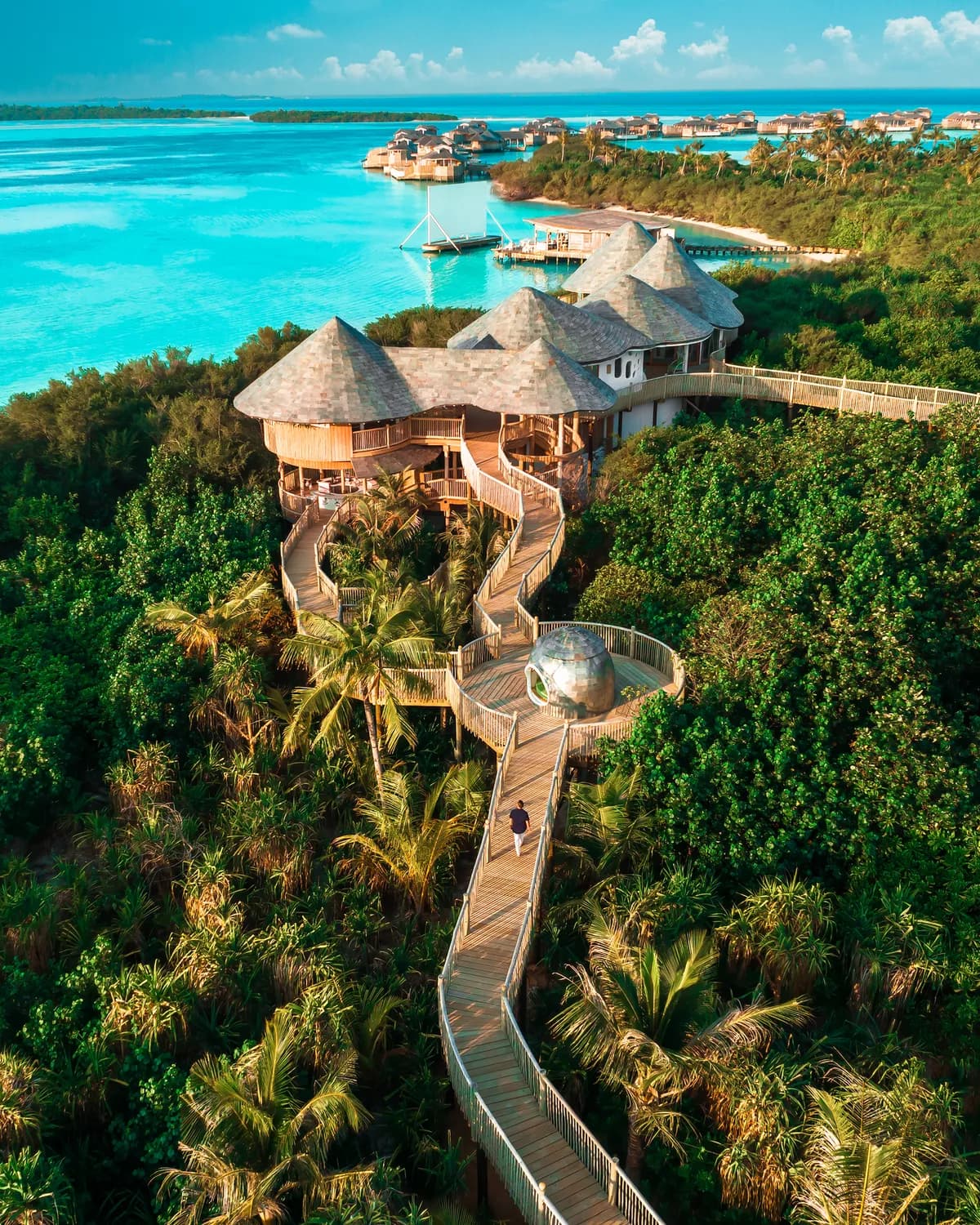
Fushi occupies the entire island of Kunfunadhoo on the southern edge of Baa Atoll. The island is roughly two kilometres long and four hundred metres at the widest, and most of the interior is dense banyan and screwpine forest with sand paths between villas. The headline product is the beach villa: large land-side residences with private pools, set under the canopy or directly on the beach. Over-water villas exist at Fushi but they are not the main inventory.
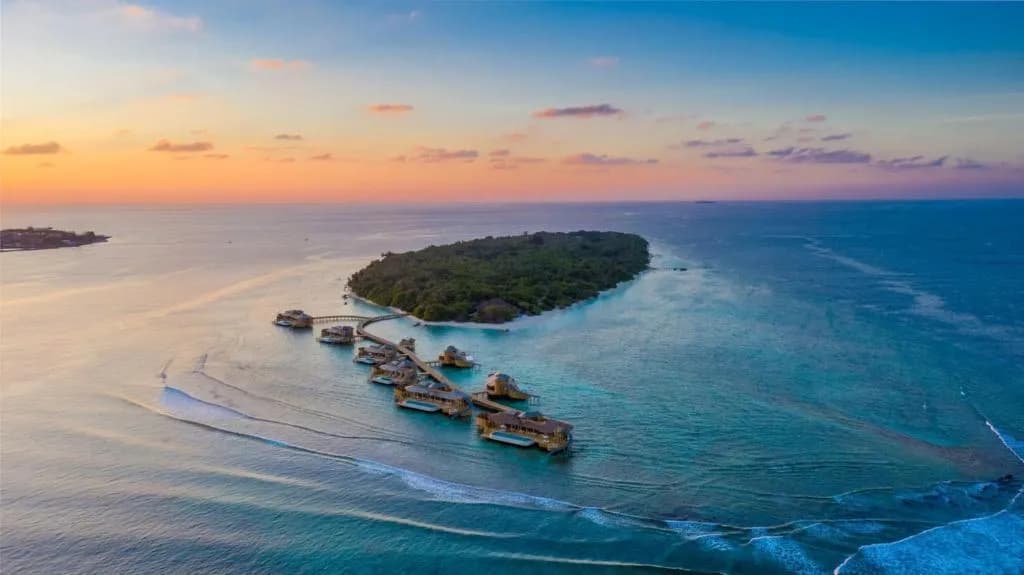
Jani sits across four interconnected sandbar islands in the Noonu Atoll lagoon. The island land mass is a fraction of Fushi's, and the headline product is the over-water villa, strung along a boardwalk that runs between the lagoon-side and reef-side waters. Several Jani over-water units carry a slide from the deck into the lagoon. Cinema Paradiso at Jani screens films from a floating screen rigged in open water.
If your mental image of a Maldives holiday is the over-water villa above turquoise lagoon water, Jani matches that image more closely than Fushi does. If your mental image is the jungle resort with private beach and outdoor showers, Fushi matches more closely. Neither is more authentic than the other, they are two answers to two different briefs.
The marine event question
Fushi sits inside the UNESCO Baa Atoll Biosphere Reserve and a short boat from Hanifaru Bay, the world's largest reef manta aggregation site, from August through November. If the trip is timed for the marine event, Fushi has the structural advantage, Hanifaru is on its doorstep, the resort runs daily permit-window boats, and the Marine Biology team is involved with the atoll's biosphere monitoring framework.
Jani has manta sightings of its own, but Noonu Atoll does not host an aggregation site at Hanifaru's scale. Jani's marine programme is strong (the Soneva DNA is intact), but the headline marine event is not on its calendar. Couples who choose Jani in October will still snorkel beautifully on the house reef; couples who go to Fushi in October may witness 100+ mantas in a single morning permit window. Different orders of experience.
Outside the manta window (December through April), the marine advantage flattens. Both resorts have strong house reefs, both run two boat dives daily, both are competent rather than exceptional at the dive operation. A trip planned outside August-November will not feel different in marine terms.
The family question
Fushi is the better choice for families with children. The kids' programme (the Den, ages 4-11) and the Eco Pro programme (11 to teen) both run substantial programming with marine biology sessions, glass studio time, and the on-island observatory. The villa stock at Fushi includes large multi-bedroom residences and connecting beach villas; family parties of four to eight are routine.
Jani's inventory leans toward two-adult occupancy. The over-water villas are designed for couples, the bedroom-to-villa ratio is lower than Fushi, and the family residences are fewer and book out earlier. Children are accommodated and welcome at Jani, but the social design of the place is honeymoon-first. A multi-generational family booking at Jani is feasible but the villa-shuffling is a real consideration.
Our reading: Fushi for families with two or more children under twelve, Jani for couples on a romantic stay, either for a couple with one older child on a slow holiday.
Pacing, transfer, and how long to stay
The transfer differs by atoll: Soneva Fushi runs a 40-minute seaplane to Baa, Soneva Jani a 45-minute seaplane to Noonu, both daylight-only between roughly 06:30 and 16:00, with an overnight at the airport hotel if your inbound flight lands after 14:30. Both resorts ask for eight to twelve nights to pay back the bill. Fushi's island scale and dense interior reward the longer stay more than Jani's lagoon footprint does.
Worst-case planning: do not book five nights at either property. The trip-report data shows the same pattern at both, five nights at Soneva reads as expensive transit. If five nights is the bill, look at smaller properties (V Villas Maldives at Mirihi, Anantara Kihavah) or shift to a North Male resort with a speedboat transfer.
The verdict in one paragraph
Soneva Fushi is the deeper Soneva: longer lineage, broader food programme, larger island scale, beach-led inventory, the canonical eco-luxury answer in the Maldives. Soneva Jani is the photogenic Soneva: over-water-led inventory, the lagoon slide, the floating cinema, a tighter brief that reads cleanly at five-to-seven nights. A first-time Soneva visitor with children should pick Fushi; a returning Soneva guest on a romantic anniversary should pick Jani; a couple who wants the slide should pick Jani; a reader who wants the deepest sustainability lineage should pick Fushi.
The recommendation matrix
Read the row that matches your shape of trip. The pick is what we would book given the constraints, with the one-line reason.
| Situation | Pick | Reason |
|---|---|---|
| First Soneva visit, family of four with two children under twelve | Soneva Fushi | Fushi's land-side villa stock, kids programme depth, larger island scale match the family brief. |
| Romantic anniversary couple, returning Soneva guest | Soneva Jani | Jani's over-water-led inventory, lagoon slide, floating cinema deliver the photogenic anniversary brief. |
| Eco-luxury reader who wants the deepest published sustainability lineage | Soneva Fushi | Fushi's 28-year framework depth and the in-house glass studio. |
| Five-night honeymoon | Soneva Jani | Jani reads cleanly at five nights; Fushi's pacing benefits from seven-plus. |
| Couple who wants the over-water villa with a slide | Soneva Jani | Only Jani has the slide. |
| Two-resort split-stay readers | Either | Pair them: four nights at Jani plus six at Fushi, or the reverse. |
| Manta-window trip in October | Soneva Fushi | Fushi sits inside Baa Atoll with Hanifaru proximity; Jani is in Noonu and accesses the manta event via a longer boat. |
Affiliate links: we may earn a commission if you book, at no cost to you. It does not affect our editorial line.