Soneva Jani
Soneva's water-villa flagship: the no-shoes philosophy applied to a string of over-water residences with retractable bedroom roofs and slides into the lagoon, on a far-north Noonu island only the seaplane reaches.
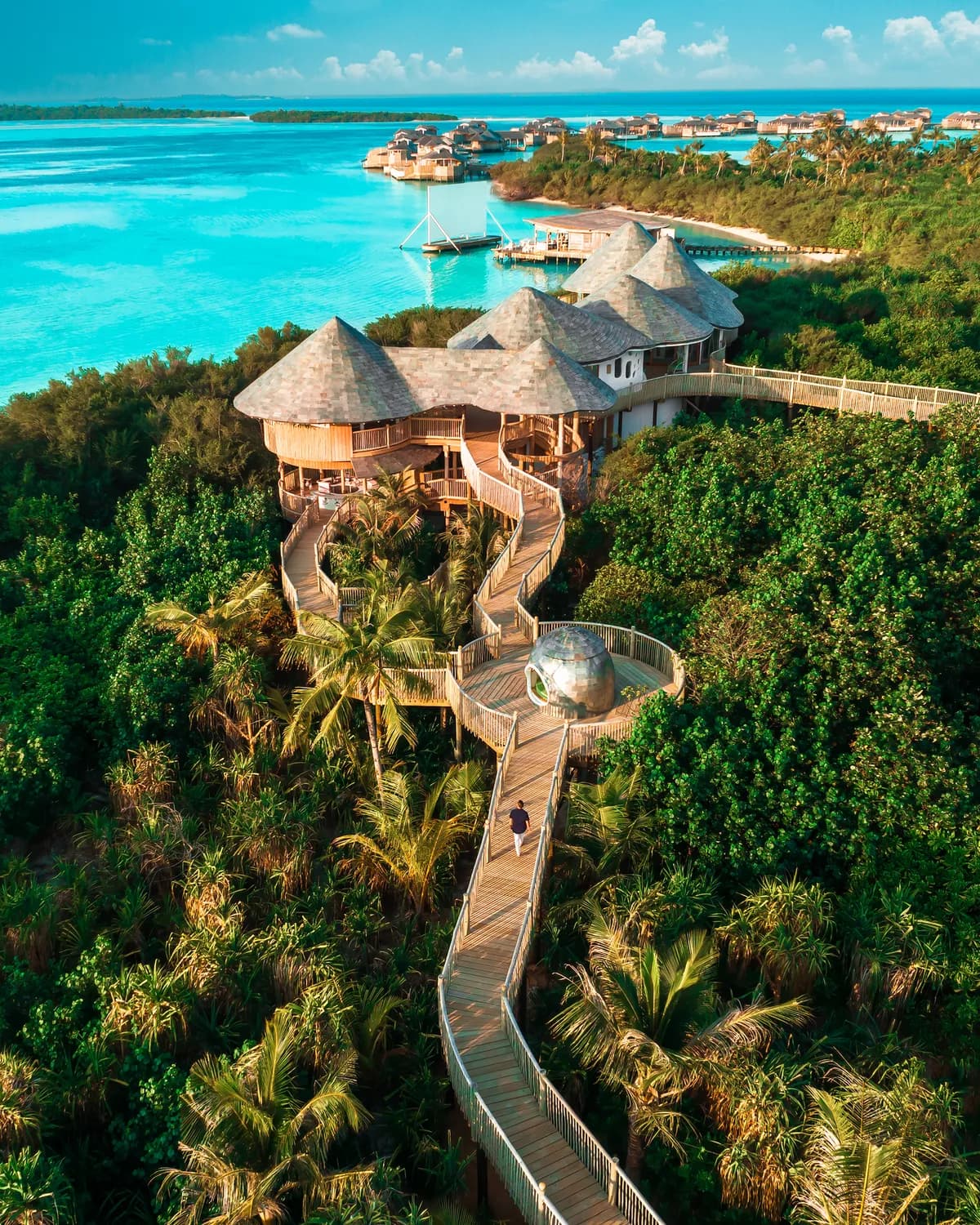
Soneva Jani is the second of the Soneva-Maldives properties, the water-villa-led answer to Fushi's jungle-island shape. The resort occupies the four interconnected islands of the Medhufaru lagoon in Noonu Atoll, a forty-five-minute seaplane from Velana, far enough north that the central-atoll cluster is a different country. The headline product is the over-water villa, strung along boardwalks between lagoon-side and reef-side waters, with retractable bedroom roofs that fold back to reveal the night sky and on a handful of categories a curving wooden slide that drops directly from the deck into the lagoon. Whether the slide is a gimmick or the right product question is the most useful one a guest can ask before booking. We answer it on this page.
Setting
Soneva Jani occupies four interconnected sandbar islands inside the 5.6-kilometre Medhufaru lagoon at the northern edge of Noonu Atoll, a long way from the central-atoll cluster. The lagoon area is the resort's structural advantage; few peer properties in the country sit inside a private lagoon of that scale. The main island carries the dining and arrival infrastructure; the other three carry the spa, the observatory, and the children's programme respectively. Boardwalks link the islands and most villa categories sit between them rather than on them.
The atoll itself is one of the quieter administrative atolls. Tourism arrived in Noonu later than in Baa or North Malé and the property cluster is smaller; in addition to Jani, Noonu hosts Cheval Blanc Randheli, JOALI Maldives, JOALI BEING, Noku, Kuredhivaru, Robinson Club, and Velaa Private Island, with a few smaller mid-tier properties on the periphery.
Critique: the over-water-heavy footprint means the beach experience at Jani is shorter than at land-based peers. A guest who wants a long sandy walk for sunrise will find the available beach length on the main island shorter than at Fushi or Cheval Blanc. The compensation is the lagoon: the under-deck water and the over-water deck become the trip's centre of gravity.
Who it's for
- Couples on a romantic or anniversary stay who specifically want the over-water photograph as the dominant feature of the holiday. Jani is configured for two adults more cleanly than any peer property in Noonu.
- Returning Soneva guests who already know what Fushi delivers and want the water-villa variant of the same philosophy. The DNA is intact; the texture of the stay differs.
- Astronomers, casual or serious. The retractable bedroom roof is the Jani feature; combined with the on-island observatory and resident astronomer, the stargazing offering at Jani is better than at any Maldivian peer.
- Travellers who can plan six to ten nights in one resort and pace it slowly. Jani's lagoon-side footprint reads thinner than Fushi's land mass; six nights here works where five would not.
Who it isn't for
- Families with three or more children. The villa inventory tilts toward two-adult occupancy; the family residences exist but the count is small and the rate jump is significant.
- Guests on a five-night stay. The seaplane transfer at both ends consumes most of two days; the cost-per-usable-day calculation gets uncomfortable below seven nights.
- First-time visitors who want a country-introduction stay. Jani is unrepresentative of mid-tier Maldivian resorts; the texture is specific and the price tier is high. Start somewhere mid-range and graduate to Jani on a return trip.
- Travellers nervous about long seaplane transfers. The Noonu seaplane to Jani is comfortably the upper end of the central-atoll seaplane window; the noise is significant and the boarding/disembarking takes longer than at closer atolls.
The villas
Jani's villa nomenclature splits into Water and Island categories, with the Water inventory carrying the slide as a defining feature of the Water Reserve and Water Retreat tiers. The Island categories are land-side residences for families. The table below covers the categories that drive the majority of bookings; specialised reserves sit beyond and are offered on enquiry.
| Villa | Size | Sleeps | Pool |
|---|---|---|---|
| 1 Bedroom Water Retreat | 410 m² | 2 | Yes |
| 2 Bedroom Water Retreat with Slide | 540 m² | 4 | Yes |
| 1 Bedroom Water Reserve with Slide | 670 m² | 2 | Yes |
| 4 Bedroom Water Reserve with Slide | 1000 m² | 8 | Yes |
| 3 Bedroom Island Reserve | 580 m² | 6 | Yes |
Food & drink
Six on-island dining venues, plus a seasonal seventh, plus the floating Cinema Paradiso dinner format which functions as a venue in its own right. So Imaginative is the open-air dinner venue under a tree canopy on the main island; the menu rotates and the chef pairs with the resident sommelier on bookable evenings. Out of the Blue, the Jani sister to the Fushi venue of the same name, is a wood-fired Japanese counter on a deck above the lagoon with sashimi sourced from local boats that morning.
So Wild is the organic-garden venue with a leaf-to-plate menu that rotates weekly with what the gardens are yielding. The Crab Shack is the casual lunch venue on a separate sandbar; the bicycle ride out is part of the offering. So Hands-On is the cooking-class kitchen with structured guest participation rather than performance dining.
The Cinema Paradiso at Jani is a floating screen rigged on a pontoon in open water, with guests seated on individual sand-tables on a connected platform. Dinner is served during the film. The format sounds like theatre and works as theatre; the surprise is that the timing, the menu and the film selection are calibrated tightly enough that it does not read as a gimmick. Book it for the second night, not the first; the first night belongs to the villa.
Diving and the house reef
The Noonu Atoll house reef at Jani sits in front of the resort's lagoon-side villas and runs to roughly 25 metres of visibility in the dry season. The reef is in better shape than the central-atoll average; Noonu sits outside the 2016 bleaching corridor that hit the central atolls hardest, and the recovery has been measurable.
Outer-reef dive sites in Noonu include Christmas Tree Rock, Faru, and the channel sites at Maavelavaru and Holhumeedhoo. The dive operation runs two boat dives daily, with manta sightings from June through October on the outer reefs and consistent encounters with grey reef sharks, eagle rays, and tuna across the year. The operation is competent rather than exceptional; if diving is the primary purpose of the trip, a Laamu or Ari-atoll dive-focused resort delivers more depth.
Honest caveat: Noonu does not host a manta-aggregation event on the scale of Hanifaru. Guests booking Jani specifically for marine spectacle should plan a side-trip across to Baa during the August-to-November window, or weigh Soneva Fushi instead.
Spa and wellness
Soneva Soul is the spa identity that anchors both Soneva Maldives properties. At Jani the spa occupies its own island in the resort's connected chain, reached by boardwalk from the main island. The pavilions are raised on stilts above the lagoon, and the arrival ritual runs a full hour before treatment begins.
The wellness programming runs deeper than at most Maldivian spa offerings. The seven-day cleanse, the most commonly booked multi-day arc, integrates body work with Ayurvedic consultation, an on-staff nutritionist, and a sleep-tracking sleep doctor. The Jani arc reads slightly better in trip reports than the Fushi equivalent on infrastructure (the Jani spa is newer) and slightly worse on practitioner roster (Fushi's lineage runs further back).
Honest caveat: peak season (December through February) books out months ahead. If a wellness arc is part of the trip, lock the slots at the time of confirming the reservation; arrival-day requests get apologetic offers of single treatments rather than the integrated programme.
Activities and the on-island programme
The retractable bedroom roof is the Jani activity that gets the most attention and deserves it. On a clear night the bedroom opens directly onto the southern Maldivian sky, and on a cloudy night the lagoon-water sound through the open roof is the second-best version. The Cinema Paradiso programme runs four to six nights weekly with a curated film list; the floating-screen format is the Jani-specific evolution of the Soneva cinema tradition.
The on-island observatory at Jani is the larger of the two Soneva observatories (Fushi's is the older). The resident astronomer runs guided sessions on the main telescope four nights a week, with structured programming for guests who want the sky-mapping arc rather than the one-off look. The astronomy team works with the marine biology team on a shared moon-and-tide calendar that guests can book against.
The slide question, finally. The slides on the Water Reserve and Water Retreat villas are a piece of physical infrastructure that drops from the villa deck into the lagoon, and the lagoon water at the entry point is two metres deep. The slide is fun for children and a photograph for adults; whether it is worth the rate uplift of a slide-equipped villa is shaped by what the trip is for. For a couples-only romantic stay the slide is incidental; for a family with children eight and up it is the trip's defining feature. Pick the villa accordingly.
Smaller offerings: Soneva in Aqua, the resort's private dive yacht; sandbar picnics with a personal chef; the Ice Cream Parlour with on-island dairy; the Chocolate Room with on-demand cacao service through the day; the bicycle pool that is the main interior transport; the dolphin cruise that runs roughly four out of five evenings in season.
Getting there
The transfer is by 45-minute seaplane on Trans Maldivian Airways, operating between roughly 06:30 and 16:00 local. Late international arrivals into Velana, anything after 14:30, typically overnight at the airport hotel and fly to Jani the next morning. The resort coordinates this transfer and absorbs part of the cost; ask the reservations desk at confirmation.
The seaplane sits at the upper end of the central-atoll window in flight time. Children under twelve are charged at roughly half the adult fare. The seaplane experience itself is part of the holiday at Jani more so than at closer atolls; the aerial view of the Noonu lagoon and the descent into Medhufaru is the trip's first photograph. Sit on the right side flying out for the strongest aerial shots.
Visa: most nationalities receive a free 30-day visa on arrival. Passport must be valid six months past entry. Departure tax is included in the airline ticket and does not need to be paid separately.
Best time to visit
Noonu's seasonality follows the central-atoll calendar with a slight northern offset. December through April is the dry window; the strongest combination of low rain probability, calm sea, and post-Christmas rate is late February through mid-March. Couples planning a honeymoon book most heavily for this window; advance reservations are advisable from roughly six months out for the larger villa categories.
May through November is the wet window. Rates drop, occasional heavy showers are common, and the manta-sighting probability on Noonu's outer reefs is higher in the August-October window. The lagoon water sits warmest in October; for guests who plan to spend most of the holiday in the under-deck water, October is the contrarian's pick.
Worst window: June, when the southwest monsoon is fully established, rates remain high because European school holidays have started, and Hanifaru's manta event has not yet begun in earnest. Late November and early December occasionally produce a dead-quiet window before the December peak; if flights are flexible, this is the value pick.
Sustainability, the numbers
Soneva Jani inherits the framework Soneva Fushi built over two decades, applied from day one at Jani in 2016. The annual sustainability report rolls up across the group with property-specific line items; the 2024 edition records on-island glass water bottling at zero single-use plastic since opening, solar contribution at roughly 24% of operational electricity, and a 2% carbon levy on every guest bill that flows into the Soneva Foundation programmes.
The Soneva Namoona initiative is the Jani-specific community programme. Working with three neighbouring Noonu local islands, Namoona has built community waste sorting infrastructure, eliminated single-use plastic at the partner-island schools, and runs an educational programme on marine plastics that is documented in peer-reviewed papers. The outputs are not theatre; the partner islands are now publishing their own waste metrics.
The seaplane transfer to Noonu remains the unavoidable fuel-intensive line. A long stay (eight nights or more) amortises the transfer more efficiently than a short one; the resort publishes the math rather than the slogan, which across the country's eco-luxury tier is rarer than the language suggests.
The Soneva group's ownership shifted in May 2025: KSL Capital Partners took majority control and the founding Shivdasani family stepped out of day-to-day operations. The framework here at Jani, including the Soneva Namoona partner-island programme and the carbon levy mechanism, was built by the founders. Whether the Foundation outflow and the group sustainability cadence hold under the new ownership is the question this site will revisit when the post-transition impact report lands.
For couples who want the over-water photograph as the trip's defining image, paced over six to ten nights, with the Soneva DNA (no-shoes, sustainability, observatory, cinema) intact, Soneva Jani is the strongest single answer in Noonu Atoll. The slide is a real consideration; the retractable roof is a quiet delight. Families with school-age children and astronomers should book here ahead of Fushi. Five-night trips and dive-primary trips should look elsewhere. For broader context on the Noonu top-tier set, the Cheval Blanc Randheli food and spa programme and the Velaa Private Island villa and cellar architecture cover the LVMH-tier and the owner-operator angles respectively; the Baa Atoll manta season frame and the Soneva Fushi eco-philosophy and food depth cover the cross-atoll Soneva comparison.
Gallery
Photographs come from each resort's own communications and operator-supplied media kits. Operators retain ownership; takedown requests are honoured on email. Click any tile to view it full size.
Alternatives we would also recommend
Soneva Fushi
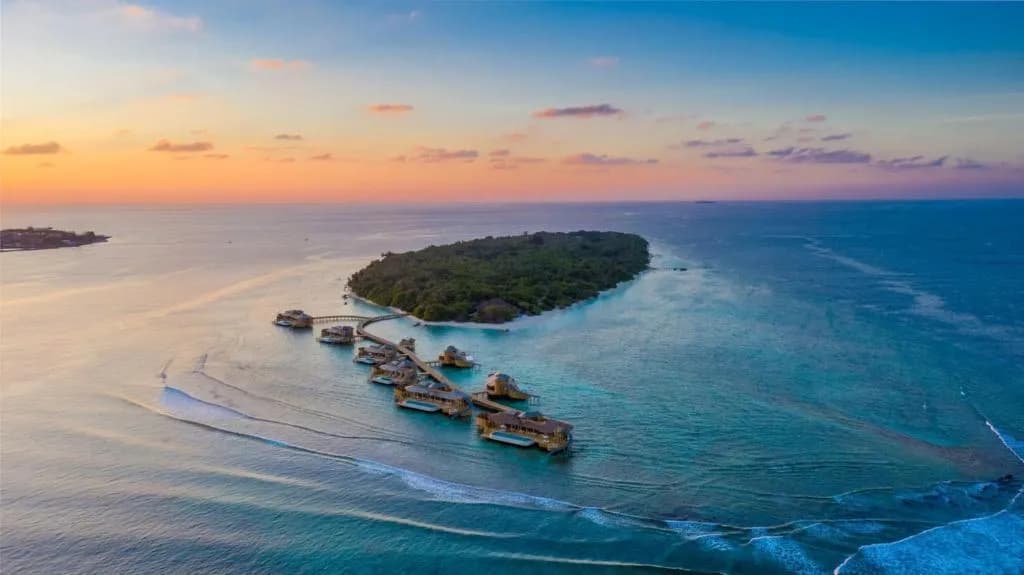
The sister property in Baa Atoll, jungle-island shape with beach villas as the headline. Same DNA, opposite footprint.
Check rates on Expedia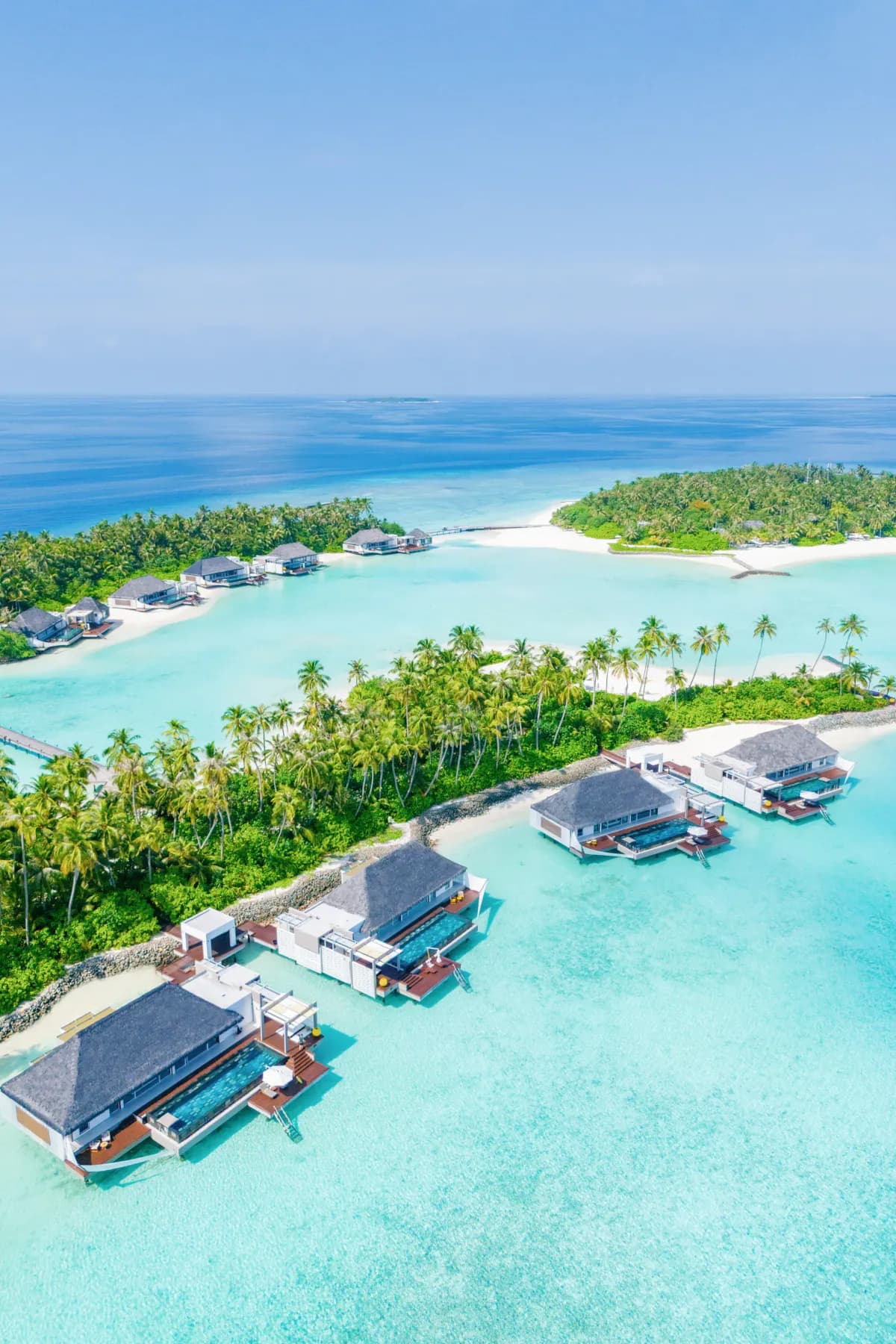
Cheval Blanc Randheli
The LVMH alternative inside the same atoll, French luxury house DNA with Jaume Plensa sculptures and a Guerlain spa.
Check rates on Expedia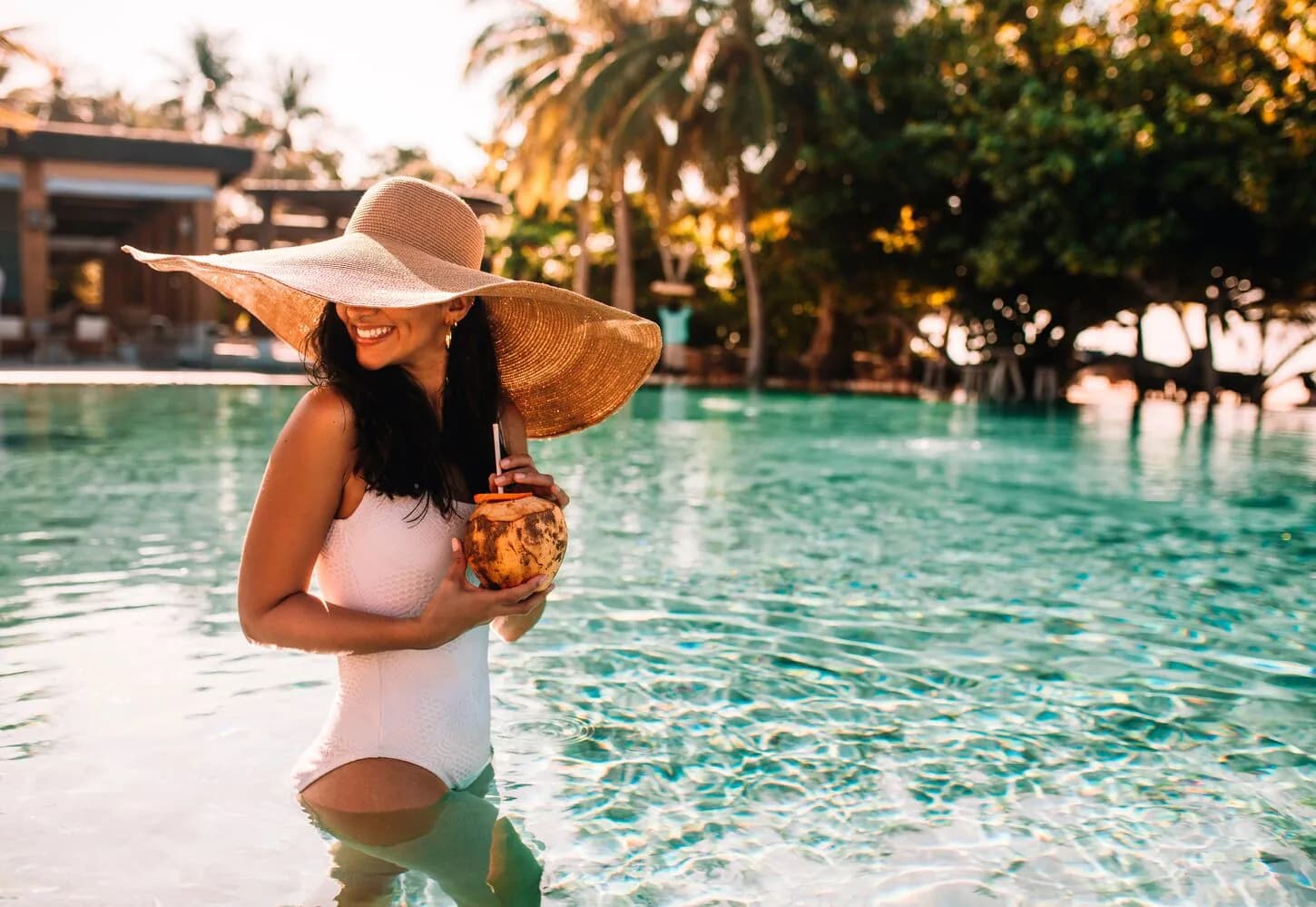
JOALI Maldives
Art-led ultra-luxury one atoll south of Noonu, with the heaviest contemporary-art programming in the country.
Check rates on ExpediaHead-to-head comparisons
Frequently asked
- Is the slide worth the upcharge on a Water Reserve?
- For families with children, yes; the trip-report data shows children-with-slide as the most consistently positive review pattern at Jani. For couples without children, the slide is incidental and the rate uplift goes to the wider villa footprint rather than the slide itself.
- How does the retractable bedroom roof actually work?
- It opens manually via a control, slides back over the bedroom roof on a track, and exposes the bed to the sky. Most guests use it once or twice during the stay rather than every night; the operational sound (rain, wind) is the limiting factor. On a clear night it is the resort's quiet best feature.
- Should I book Jani or Fushi for a first Soneva visit?
- Fushi for a first visit, Jani for a return. Fushi is the older property, the heavier sustainability lineage, the broader villa stock for families. Jani is the over-water specialisation that reads better against a Fushi baseline.
- Is Noonu Atoll a good choice for diving?
- Competent rather than exceptional. The house reef is in better shape than the central-atoll average and the outer-reef sites are interesting; manta sightings increase from June through October. For diving-primary trips, a Laamu or Ari resort delivers more depth.
- How does the seaplane transfer compare to closer atolls?
- Jani is at the upper end of the central-atoll seaplane window at 45 minutes. The same daylight-only operation (06:30-16:00) applies; late international arrivals overnight at the airport hotel. The Noonu seaplane experience is the trip's first photograph if the aerial counts for you.
- What's the dress code for dinner?
- Resort casual everywhere; no jackets required at any venue. Out of the Blue is the only place where booking ahead is essential; the rest accept walk-ins. Cinema Paradiso requires booking for the floating-screen evenings.
Last verified 2026-05-27. Next refresh 2026-08-27. Edited by Linus Halberg.