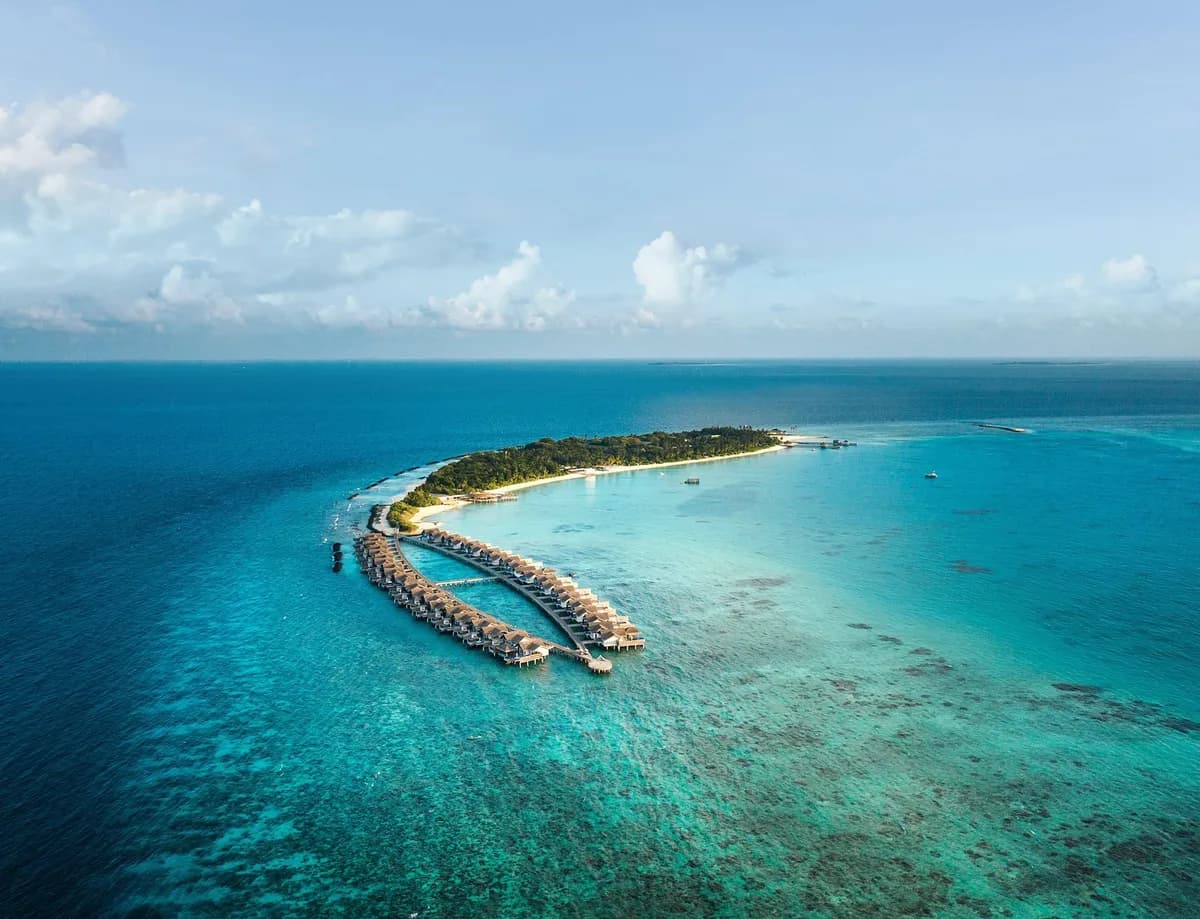
Sirru Fen Fushi, Private Lagoon Resort (previously Fairmont Maldives Sirru Fen Fushi)
Eco-luxury anchor on the 96-acre Gaakoshinbi island in Shaviyani Atoll, opened May 2018 as Fairmont Maldives Sirru Fen Fushi under Accor group and rebranded May 2024 to Sirru Fen Fushi, Private Lagoon Resort under Leading Hotels of the World portfolio. 120 villas across Beach, Jungle, and Overwater configurations on one of the country's largest single-island lagoons, three restaurants (Azure, Kata, Raha Market), the Willow Stream Spa, and a 55-minute twin-otter seaplane from Velana.
Sirru Fen Fushi, Private Lagoon Resort (operating under that name since 1 May 2024) occupies the 96-acre Gaakoshinbi island at the western reef edge of Shaviyani Atoll, roughly 220 kilometres north of Velana International and reached by a 55-minute twin-otter seaplane direct from the Trans Maldivian Airways platform with the audio-guided barefoot-pilot briefing. The property opened in May 2018 as Fairmont Maldives Sirru Fen Fushi under the Accor group umbrella; on 1 May 2024 the property transitioned away from the Fairmont brand and joined the Leading Hotels of the World portfolio under the new operating name. The structural identity is the 120-villa configuration spread across one of the country's largest single-island lagoons (the lagoon is roughly four times the island footprint, the 'Secret Water Island' branding the property carries through both brand iterations), the eco-luxury marine-conservation programme integrated into the daily activity arc, and the three-restaurant concentrated food programme led by Azure fine dining and Kata Japanese. Across the wider Shaviyani cluster, the property pairs with the chain-luxury JW Marriott Maldives Resort & Spa on Vagaru as the atoll's eco-luxury alternative at materially larger scale; the Soneva Fushi audited-sustainability framework in Baa is the framework-depth comparator at the country's deepest published level, and the Cheval Blanc Randheli LVMH Maison polish in neighbouring Noonu is the polish-tier comparator at the higher price point. Whether the eco-luxury LHW positioning, the large-lagoon structural identity, and the Far North transit length are the right answer for a stay is the page's main question.
Setting
Gaakoshinbi is a 96-acre natural island at the western reef edge of Shaviyani Atoll, with the lagoon system running roughly four times the island footprint (one of the country's largest single-island lagoon configurations). The 120-villa stock rings the western, southern, and eastern lagoon perimeters with the central interior carrying the three dining venues, the Willow Stream Spa pavilion, the main pool, and the kids club.
Design language follows the eco-luxury contemporary-tropical convention: locally sourced timber, generous use of glass and natural materials, and the brand-standard luxury portfolio aesthetic. The villa interiors run at the LHW boutique-luxury consistency rather than the LVMH-bespoke or Maldivian-vernacular alternatives.
Critique: the 96-acre scale produces meaningful inter-villa walking distances; the island layout supports buggy or bicycle transport. The structurally large lagoon plus the 120-villa scale produces a slightly less intimate ambiance than the boutique single-purpose Maldivian alternatives; for couples chasing the small-island intimacy photograph, the Noku Maldives 50-villa boutique on Kudafunafaru in neighbouring Noonu is the smaller-scale comparator.
Who it's for
- Couples or families wanting the country's largest single-island lagoon. The 96-acre Gaakoshinbi island runs a lagoon roughly four times the island footprint; the 'Secret Water Island' branding marketed the structural scale of the protected water through both Fairmont and Leading Hotels of the World brand iterations. For couples for whom the lagoon as a stay-defining feature is the principal reason for the trip, the property is the country's clearest answer.
- Eco-luxury travellers wanting a credible marine-conservation programme integrated into the activity arc. The on-property marine biologist plus the dedicated coral-restoration and reef-monitoring work runs the standard eco-luxury cadence; the structural quiet of the far-north Shaviyani booking density (lower than central-atoll cluster) supports the conservation outcomes.
- Travellers wanting Leading Hotels of the World portfolio integration. The May 2024 brand transition brought the property into the LHW collection with the brand's curated luxury portfolio; for travellers staging multi-property stays across the LHW network (including the major European and Asian luxury hotels), the property is the country's principal LHW Maldivian entry.
- Couples wanting the three-villa-category variety. The Beach Villas line the western lagoon edge, the Jungle Villas tuck into the island interior canopy, and the Overwater Villas extend into the protected lagoon. The configuration breadth runs materially wider than the typical Maldivian luxury single-category property.
Who it isn't for
- Travellers wanting LVMH or Aman-tier polish at the service-seam tier. The on-property service runs at the eco-luxury LHW standard rather than the LVMH Maison cadence; for readers prioritising the next polish tier, [Cheval Blanc Randheli in neighbouring Noonu](/resorts/cheval-blanc-randheli) is the structural comparator at a materially higher price point.
- Couples wanting Soneva-tier audited sustainability reporting. The marine-conservation programme is credible at the operational level, but the published-impact-report cadence does not match the [Soneva-audited annual impact report](/resorts/soneva-fushi) framework depth. For audited eco-luxury, Soneva sits ahead.
- Travellers wanting the central-atoll seaplane-direct routing under 45 minutes. The Gaakoshinbi routing is materially longer than the central Baa or North Male alternatives; the 55-minute twin-otter seaplane sits at the upper end of the dry-window seaplane bracket. Readers prioritising minimum-transit should compare the [North Male properties at 25 to 45 minutes](/atolls/north-male) or the [Baa Atoll seaplane cluster](/atolls/baa-atoll).
- Travellers sensitive to the brand-transition naming overlap. Through the 2024 to 2026 transition the property carries both Fairmont Maldives Sirru Fen Fushi (legacy collateral, Accor microsite holdover) and Sirru Fen Fushi, Private Lagoon Resort (current LHW marketing, on-island signage). Confirm booking details under both names to avoid the naming ambiguity.
The villas
The 120 villas split across three structural configurations: Beach Villas along the western lagoon edge, Jungle Villas tucked into the island interior tropical canopy, and Overwater Villas extending into the protected lagoon. Selected categories carry private pools; the family-villa configurations sleep up to six.
| Villa | Size | Sleeps | Pool |
|---|---|---|---|
| Beach Sunrise Villa | 175 m² | 3 | No |
| Beach Sunset Pool Villa | 235 m² | 3 | Yes |
| Beach Family Pool Villa | 320 m² | 6 | Yes |
| Jungle Pool Villa | 195 m² | 3 | Yes |
| Water Sunrise Villa | 195 m² | 3 | No |
| Water Sunset Pool Villa | 245 m² | 3 | Yes |
| Three Bedroom Beach Reserve | 565 m² | 8 | Yes |
Food & drink
Three restaurants plus the in-villa and destination dining programmes. Azure is the fine-dining configuration with the sommelier-led wine programme and the contemporary international menu. Kata is the Japanese kitchen running sashimi, sushi, and the teppanyaki theatre-cooking pavilion. Raha Market is the all-day market concept with the live-cooking stations covering breakfast through dinner.
Two bars round out the food-and-beverage inventory: the main pool bar and the dedicated cocktail-and-cigar lounge. The destination dining programme covers sandbank picnics on the wider Shaviyani lagoon network, in-villa floating-breakfast configurations, and the private overwater pavilion dinner setup.
The dining read worth flagging: the three-venue footprint sits at the smaller end of the chain-luxury Maldivian cluster. Guest commentary divides between couples praising the concentrated quality (especially Kata's Japanese depth) and couples missing the rotation breadth. The 2018 Fairmont opening established the dining cadence; the 2024 LHW transition retained the venue configuration.
Diving and the house reef
The on-property dive centre runs the standard eco-luxury two-boat-dives-daily cadence plus the dedicated marine-biologist programme on the protected lagoon. Visibility on the Shaviyani channel network runs to 25 to 30 metres in the dry window from December through April.
The house reef on the Gaakoshinbi lagoon edge and the wider 96-acre lagoon system runs at competent depth with the in-house coral conservation programme structuring guest engagement. Outer-reef sites within tender range include the named thila and channel sites; the wider Shaviyani reef catalogue extends into the seasonal manta-aggregation window on the western flank.
The dive operation is competent at the eco-luxury standard with the marine-biologist programme as the structural differentiator. For a dive-primary trip the Six Senses Laamu dive programme or the South Ari whale-shark routing remain the structural country-wide answers; Sirru Fen Fushi is the right choice when the conservation-led dive layer sits alongside the eco-luxury stay.
Spa and wellness
Willow Stream Spa runs the property's wellness programme from a central-interior pavilion configuration retained from the Fairmont era. The treatment menu covers massage, facial, body-and-scrub, plus the dedicated Asian wellness and Ayurveda strands. The Willow Stream brand identity is the structural spa-tier identity that the property carries through the LHW brand transition.
Additional facilities include the steam room, the relaxation lounge, the manicure-pedicure salon, and the yoga pavilion with daily group sessions plus private-instructor allocation. The wellness programme integrates with the marine-conservation work through the dedicated lagoon-side meditation sessions.
Willow Stream runs at eco-luxury LHW depth rather than at wellness-resort-first framework. For wellness-immersion as the trip's structural identity, JOALI BEING at Bodufushi sits ahead. Sirru Fen Fushi's spa programme operates as the strong secondary wellness layer alongside the eco-luxury identity.
Activities and the on-island programme
The watersports programme runs the broad eco-luxury catalogue: stand-up paddleboarding, kayaking, sailing on a small fleet, jet-ski tours, parasailing in the dry-window cross-shore wind, and the lagoon-side snorkel-guide trips on the protected lagoon. The 96-acre lagoon scale supports extended in-lagoon watersports the smaller-island Maldivian luxury alternatives cannot match.
The marine-conservation programme is the property's structural differentiator. The in-house marine biologist runs guided reef walks, coral-planting sessions, turtle-monitoring excursions, and the dedicated education programme for children and teens. The dive centre integrates with the conservation work through the on-property programme cadence.
Family and kids programming: the kids club covers ages 4 to 12 with structured daily activities including the marine-biology sessions; the teen programming layer for ages 13 to 17 includes the conservation work alongside the watersports access; the family-villa configurations with private pools support the multi-generational stay. The wider Shaviyani cluster pairs with the JW Marriott Maldives Vagaru cross-property dive-day option for the broader atoll exploration.
Getting there
The standard routing from Velana International is a 55-minute twin-otter seaplane direct via Trans Maldivian Airways from the Velana seaplane terminal to the resort lagoon. The audio-guided barefoot-pilot briefing reinforces the Far North seaplane experience as a structural feature.
The seaplane runs daylight-only (roughly 06:30 to 16:00 local) so international arrivals after 14:00 typically overnight at the Velana airport hotel before connecting next morning. Domestic-flight backup routing via Hanimaadhoo (HAQ) in neighbouring Haa Dhaalu plus a 35 to 45 minute speedboat exists as an operator-arranged alternative for late-arrival travellers; the routing is less common than the seaplane direct.
Visa: most nationalities receive a 30-day free visa on arrival; passports must be valid six months past entry. The LHW arrival programme runs the brand-standard pre-arrival service for the luxury portfolio guest flow.
Best time to visit
Far North Shaviyani seasonality follows the central-north pattern with slight northern offset. December through April is the dry window; January through March is the cleanest combination of weather, lagoon clarity, and post-Christmas booking pressure. The 120-villa inventory books three to four months ahead for the Christmas and February half-term peak windows.
May through November carries the southwest monsoon. Rates drop materially, the all-inclusive plan availability opens up, and the Shaviyani western-reef manta-aggregation window peaks (August through October). The eastern reef orientation catches the wet-season swell; readers booking an Overwater Sunset Pool Villa during this window should request a sheltered aspect.
For LHW-eco-luxury travellers, late November is the window worth chasing. The wet-season winds have settled by then but the family-villa availability is still open; the Shaviyani manta tail continues producing sightings before the December rate spike arrives.
Sustainability, the numbers
On-island sustainability runs the eco-luxury standard set: the in-house marine biologist plus the dedicated coral conservation programme structure the marine-environmental work, filtered still and sparkling water bottled on property, single-use plastic restricted across food and beverage, LED-and-solar power-mix on the back-of-house grid, and the standard reef-monitoring and beach-clean cadence.
Marine programming runs through the marine biologist plus the dive centre. The reef-monitoring and turtle-tagging work runs at credible eco-luxury depth (genuine rather than headline-pillar); the property markets the marine-conservation work as the secondary identity layer alongside the lagoon-as-feature framing.
What you will not find: a property-specific audited annual impact report at the Soneva framework depth, a carbon levy on the bill, or a community-island NGO programme at the deep-engagement scale. The eco-luxury framework operates at the operational rather than the audited-publication tier.
For couples or families wanting the country's largest single-island lagoon, the eco-luxury marine-conservation programme with the in-house marine biologist, the three-villa-category variety, and the new Leading Hotels of the World portfolio integration at far-north Shaviyani positioning, Sirru Fen Fushi, Private Lagoon Resort is the right answer on Gaakoshinbi. The 120 villas including the Three Bedroom Beach Reserve, the three-restaurant Azure plus Kata Japanese plus Raha Market market dining programme, the Willow Stream Spa, and the 55-minute twin-otter seaplane from Velana are the headline features. The eco-luxury polish sitting below the LVMH-Maison tier, the marine-conservation framework below the Soneva-audited cadence, the brand-transition naming overlap (Fairmont to LHW), and the far-north transit length are the honest trade-offs.
Gallery
Photographs come from each resort's own communications and operator-supplied media kits. Operators retain ownership; takedown requests are honoured on email. Click any tile to view it full size.
Alternatives we would also recommend
JW Marriott Maldives Resort & Spa
Same-atoll chain-luxury alternative on Vagaru. 60 villas including the Duplex configurations, six dining venues led by the Kaashi treetop Thai lunch, Bonvoy Cat 7 redemption.
If Marriott Bonvoy loyalty and the broader six-venue dining are priority over eco-luxury LHW positioning
Soneva Fushi
The brand's central-atoll Kunfunadhoo property, 108 villas at the sand-floored family scale, audited sustainability framework, deeper food-venue rotation, central-atoll seaplane transit.
If audited sustainability framework depth and central-atoll transit are priority over far-north positioning
Cheval Blanc Randheli
LVMH Maison polish at 45-villa Noonu scale, Guerlain spa, French luxury-house DNA, 30-min seaplane from Velana.
If LVMH-tier polish and ultra-luxury price-no-object positioning are priority over eco-luxury LHW positioning
Frequently asked
- What is the May 2024 brand transition from Fairmont to LHW?
- On 1 May 2024 the property concluded its six-year operating agreement under Accor's Fairmont brand and joined the Leading Hotels of the World portfolio under the new operating name Sirru Fen Fushi, Private Lagoon Resort. The on-island infrastructure, villa stock, dining programme, spa, and operational staff are continuous through the brand transition; the change brings the LHW portfolio integration (LHW Leaders Club loyalty) and the simpler 'Sirru Fen Fushi' marketing identity. Confirm the booking details under both Fairmont Maldives Sirru Fen Fushi (legacy collateral) and Sirru Fen Fushi, Private Lagoon Resort (current LHW marketing).
- Is the 96-acre lagoon scale genuinely distinctive in the Maldivian cluster?
- Yes, structurally. Gaakoshinbi's lagoon system runs roughly four times the island footprint at 96 acres total; only a small handful of Maldivian luxury properties operate comparable lagoon-as-feature configurations. The 'Secret Water Island' branding marketed the structural scale through both brand iterations; for couples or families for whom the lagoon as a stay-defining feature is the principal reason for the trip, the property is the country's clearest answer at this scale.
- How does the marine-conservation programme actually work?
- The in-house marine biologist coordinates daily guided reef walks, weekly coral-planting sessions, monthly turtle-tagging excursions, and the dedicated children-and-teen marine-biology education programme. The 96-acre lagoon scale supports the conservation work at credible depth (rather than the headline-pillar level). For couples wanting an educational layer to the holiday brief, the programme is the property's structural differentiator at this transfer band.
- How does Sirru Fen Fushi compare to JW Marriott Vagaru in the same atoll?
- Different positioning. Sirru Fen Fushi Private Lagoon Resort runs 120 villas at the eco-luxury LHW tier on Gaakoshinbi with the marine-conservation programme and the structurally large lagoon. JW Marriott Vagaru runs 60 villas at the chain-luxury Bonvoy-loyalty tier on Vagaru with the Kaashi treetop Thai signature and the six-venue dining programme. For Bonvoy loyalty and the broader dining rotation, JW Marriott; for eco-luxury LHW positioning and the lagoon-as-feature stay, Sirru Fen Fushi.
- Is the sustainability work at Sirru Fen Fushi at Soneva level?
- No. The on-island marine-conservation programme is credible at the operational level (the marine biologist plus the coral conservation work runs at genuine eco-luxury depth), but the published-impact-report cadence does not match the Soneva-audited annual impact report or the Six Senses Laamu deep community-island work. For operational marine-conservation eco-luxury, Sirru Fen Fushi runs at credible depth; for the audited-publication or carbon-levy-on-bill framework, Soneva sits ahead.
Last verified 2026-05-14. Next refresh 2026-08-14. Edited by Linus Halberg.