Soneva Fushi vs Six Senses Laamu, for the eco-luxury reader
Affiliate links: we may earn a commission if you book, at no cost to you. It does not affect our editorial line.
What the two resorts share
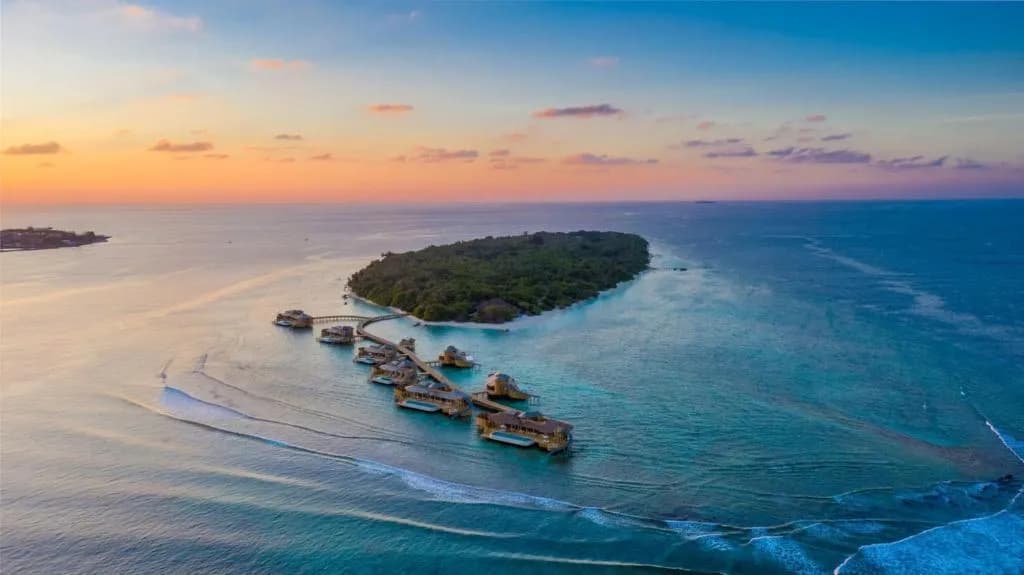
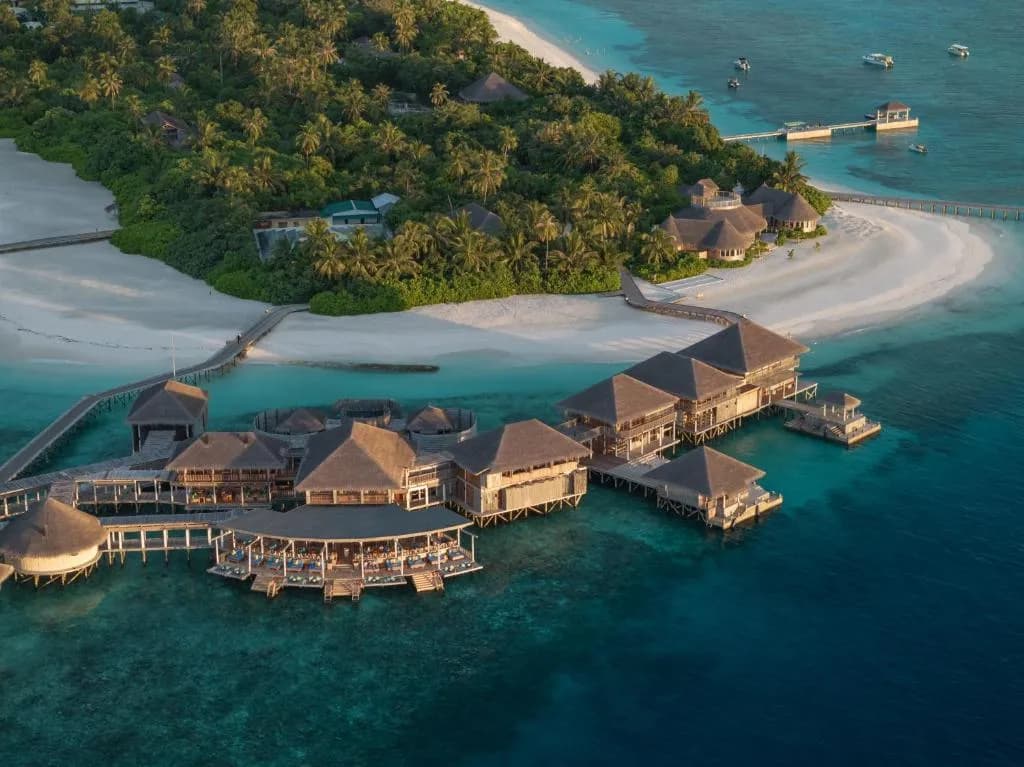
Both Soneva Fushi and Six Senses Laamu are independent-island resorts at the eco-luxury tier with a sustainability story published in audited numbers rather than language. Both run an in-house glass water bottling operation. Both restrict single-use plastic to zero, both run a kids' programme with substance, and both publish a property-specific sustainability report at a cadence that exceeds the industry standard.
The wine programmes are at a similar level: Soneva Fushi runs a deeper cellar (the 12,000-bottle lineage compounded since the mid-1990s), Laamu runs a smaller cellar with a closer-to-fair markup. The dining counts are equivalent at six on-island venues each, with property-specific best dishes rather than overall-better. A serious eater will be happy at either.
If you have stayed at one and you book the other, the cadence of the day-to-day experience will read familiar within forty-eight hours. The choice is not between brands; it is between two products designed for slightly different briefs.
Where they diverge: the marine programme
Six Senses Laamu has the country's most editorially engaged marine biology programme. The on-island Maldives Underwater Initiative (MUI) lab staffs three NGO partnerships from the property: the Olive Ridley Project for sea turtle rehabilitation, the Manta Trust for citizen-science manta logging, and the Blue Marine Foundation for atoll-wide protected-area research. The outputs include peer-reviewed papers and policy submissions to the Maldivian environment ministry.
Soneva Fushi's Marine Biology team is competent and engaged with the Baa Atoll biosphere monitoring framework, but the depth of programming sits below Laamu's. Fushi's advantage is event-based: the proximity to Hanifaru Bay from August through November means that during the manta-aggregation window, Fushi delivers a marine spectacle Laamu cannot match. Outside that window, Laamu pulls ahead on substance.
Our reading: if the trip is timed for the manta window and the marine event is the reason to travel, Fushi. If the trip is at any other time of year and marine biology depth is the draw, Laamu.
Surf, diving, and house-reef condition
Surf is the Laamu-specific advantage and one of the strongest single arguments for the long southern transfer. The Yin Yang break out front is a fast right-hander that runs consistently overhead from late April through October on a southwest swell; the resort also runs guided trips to Machine and Isdhoo within the atoll. Trip-report data ranks the Laamu surf programme in the top three Maldivian options. Soneva Fushi does not have a comparable surf offering.
On diving, Laamu's house reef has been documented to recover faster than Fushi's since the 2016 warming event because Laamu sits outside the central-atoll bleaching corridor. The Laamu dive operation runs at a pace closer to a dedicated dive resort than a luxury chain. Fushi's dive operation is competent rather than exceptional, and the marquee dive experience at Fushi is the Hanifaru permit window during the manta season, not the daily boat dives.
Bottom line: for a divers-and-surfers trip, Laamu is unambiguously the stronger property. For a marine-event-tourist trip, Fushi wins for the August-November window.
Polish, operational consistency, and the napkin-seam guest
Soneva Fushi's operational polish runs higher than Laamu's. The trip-report data over the last three seasons consistently shows Fushi with slightly fewer service-consistency complaints, slightly tighter timing on dining service, and a slightly higher returning-guest rate. Laamu is good rather than perfect; Fushi is good closer to perfect.
The guest who notices the seam on a napkin will notice it more often at Laamu than at Fushi. Laamu's compensation is the substance (marine programme, surf, sustainability transparency) sitting above what Fushi delivers on those specific axes. Choose Fushi for polish; choose Laamu for substance.
Honest caveat on Fushi: the kids' programme is structurally heavier than Laamu's. Families with three or more children, especially with under-fives, will find Fushi the easier operation despite Laamu's marine biology angle for older children.
Transfer, pacing, and how long to stay
Fushi runs a 40-minute seaplane to Baa Atoll, daylight-only between roughly 06:30 and 16:00. Late international arrivals overnight at the airport hotel. Laamu runs a 50-minute domestic flight to Kadhdhoo plus a 15-minute speedboat, on a schedule that extends to 21:00. For travellers landing late on long-haul flights, Laamu's schedule resilience is the practical advantage; for travellers landing in the morning, the seaplane experience at Fushi is closer to a holiday in itself.
Both resorts ask for eight to twelve nights to pay back the bill. Five-night trips read as expensive transit at either. The marine programme at Laamu reveals more in the second week than the first, particularly the wellness arc and the dive site rotation; we would book Laamu for ten nights minimum, Fushi for eight.
The transfer fares are quoted at booking and shift seasonally; we do not duplicate the figures in editorial prose until a partner feed is signed.
The verdict in one paragraph
Soneva Fushi is the safer first choice for a first-time eco-luxury visit, particularly if the trip is timed for the manta window, the party includes young children, or the priority is operational polish. Six Senses Laamu is the more interesting second-or-third choice for the reader who already knows what Fushi delivers and wants the marine biology depth, the surf, or the southern-atoll solitude. The price gap covers the difference in transfer cost; the value gap depends on which axis matters more to you.
The recommendation matrix
Read the row that matches your shape of trip. The pick is what we would book given the constraints, with the one-line reason.
| Situation | Pick | Reason |
|---|---|---|
| First eco-luxury Maldives trip, eight to ten nights, October | Soneva Fushi | Manta window timing favours Fushi; Hanifaru proximity is the trip's defining feature. |
| Surfers who also want luxury, May through October | Six Senses Laamu | Yin Yang break is the southern-atoll right-hander; Fushi has no surf programme. |
| Family with two children under six, twelve nights, February | Soneva Fushi | Fushi's kids' programme depth, larger multi-bedroom villas, and easier transfer for tired children. |
| Couple on a stay timed outside the manta window, March or May | Six Senses Laamu | Laamu's marine biology programme depth pulls ahead when there's no Hanifaru event to anchor a Fushi visit. |
| Diver-primary trip, ten or more nights, year-round | Six Senses Laamu | Laamu's reef condition, channel dive sites, and dedicated dive operation pace. |
| Returning Soneva guest looking for sister-property texture | Neither | Soneva Jani is the better answer for that brief; Laamu is a different chain entirely. |
| Long-haul traveller landing at Velana after 18:00 | Six Senses Laamu | Laamu's domestic flight operates until 21:00; Fushi's seaplane curfew forces an airport-hotel overnight. |
Affiliate links: we may earn a commission if you book, at no cost to you. It does not affect our editorial line.